
Machine-learning molecular dynamics reveals distinct dynamical and spectroscopic signatures of low- and high-density liquid water, advancing the search for the elusive liquid–liquid critical point.
Application sectors: Advanced materials and chemical modeling, Spectroscopy and experimental physics, Energy and environmental technologies.
Keywords: supercooled water, machine learning potentials, molecular dynamics, infrared spectroscopy, phase transitions.
Water’s anomalous behaviour, especially under supercooled conditions, remains one of the most intriguing problems in condensed matter physics. A leading hypothesis suggests that water can exist in two distinct liquid phases, a high-density liquid (HDL) and a low-density liquid (LDL), separated by a liquid–liquid critical point (LLCP). While thermodynamic evidence for this scenario has accumulated, direct experimental confirmation and a detailed understanding of the microscopic dynamics have remained elusive.
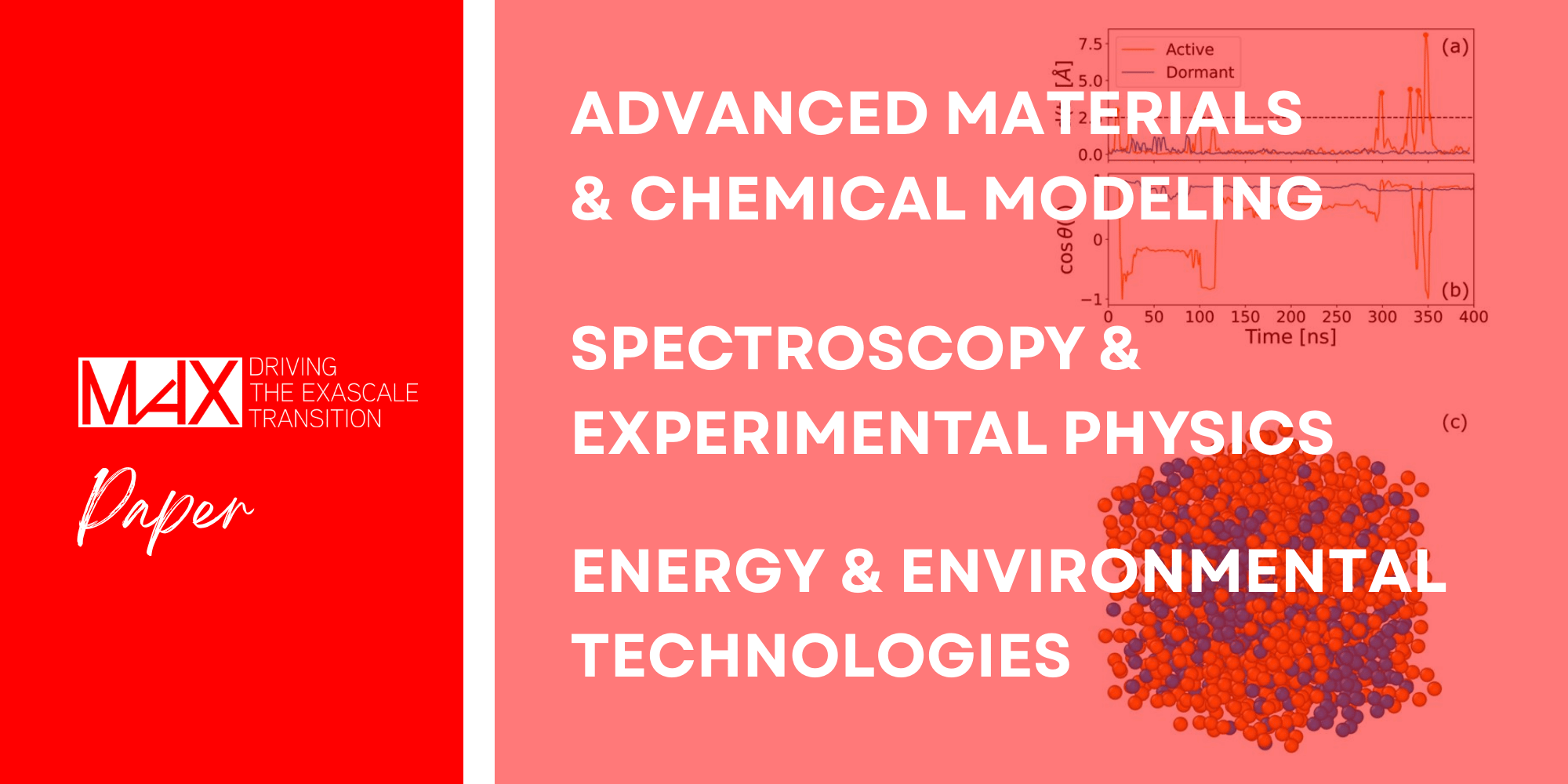
This work provides new insights into the dynamical and spectroscopic differences between HDL and LDL. The key finding is that LDL exhibits markedly slower, highly heterogeneous molecular motion, with many molecules effectively trapped over long timescales, while HDL behaves as a more homogeneous, diffusive liquid. This contrast was quantified using the van Hove correlation function and mobility classification into active and dormant molecules.
On the spectroscopic side, infrared (IR) analysis revealed a clear blueshift and narrowing of the libration band in LDL, indicating a more rigid and strongly correlated hydrogen-bond network. Crucially, these spectral differences arise from enhanced collective dipole correlations, providing experimentally accessible fingerprints of the two liquid states. Together, these results offer a coherent microscopic picture linking structure, dynamics, and spectroscopy in supercooled water.
Implications
This study establishes clear dynamical and spectroscopic fingerprints distinguishing low- and high-density liquid water. The identification of sluggish, heterogeneous dynamics in LDL and its distinct infrared signature, particularly in the librational band, provides guidance for experimental efforts seeking to confirm the liquid–liquid transition.
Beyond fundamental science, these insights have broader implications. Understanding water’s behavior at extreme conditions is critical for fields ranging from cryopreservation and atmospheric science to energy systems where water plays a key role under non-standard conditions. The demonstrated methodology also sets a benchmark for studying other complex liquids and phase transitions with similar accuracy.
The integration of machine learning with first-principles simulations and spectroscopy opens new pathways for predictive materials modeling. Future work will likely focus on direct comparison with experimental IR and Raman data and extending simulations deeper into experimentally inaccessible regimes.
Interested in applying ML-driven HPC workflows to complex materials? Talk to us or explore the MaX code ecosystem to accelerate your simulations and bridge theory with experiment.
Reference paper
Dynamical heterogeneity in supercooled water and its spectroscopic fingerprints. C. Malosso, E. D. Donkor, S. Baroni, and A. A. Hassanali
Journal of Chemical Physics, 163 (14), 144508 (2025). https://doi.org/10.1063/5.0288343