Skip to content
  • About MaX
  • Software & Data
  • Impact & Outcomes
  • Training
  • News
  • Agenda
  • Contact
  • About MaX
  • Software & Data
  • Impact & Outcomes
  • Training
  • News
  • Agenda
  • Contact
  • About MaX
  • Software & Data
  • Impact & Outcomes
  • Training
  • News
  • Agenda
  • Contact
  • About MaX
  • Software & Data
  • Impact & Outcomes
  • Training
  • News
  • Agenda
  • Contact
  • About MaX
  • Software & Data
  • Impact & Outcomes
  • Training
  • News
  • Agenda
  • Contact

Home / News

  • All News
  • HPC collaboration
  • Publications
  • All News
  • HPC collaboration
  • Publications

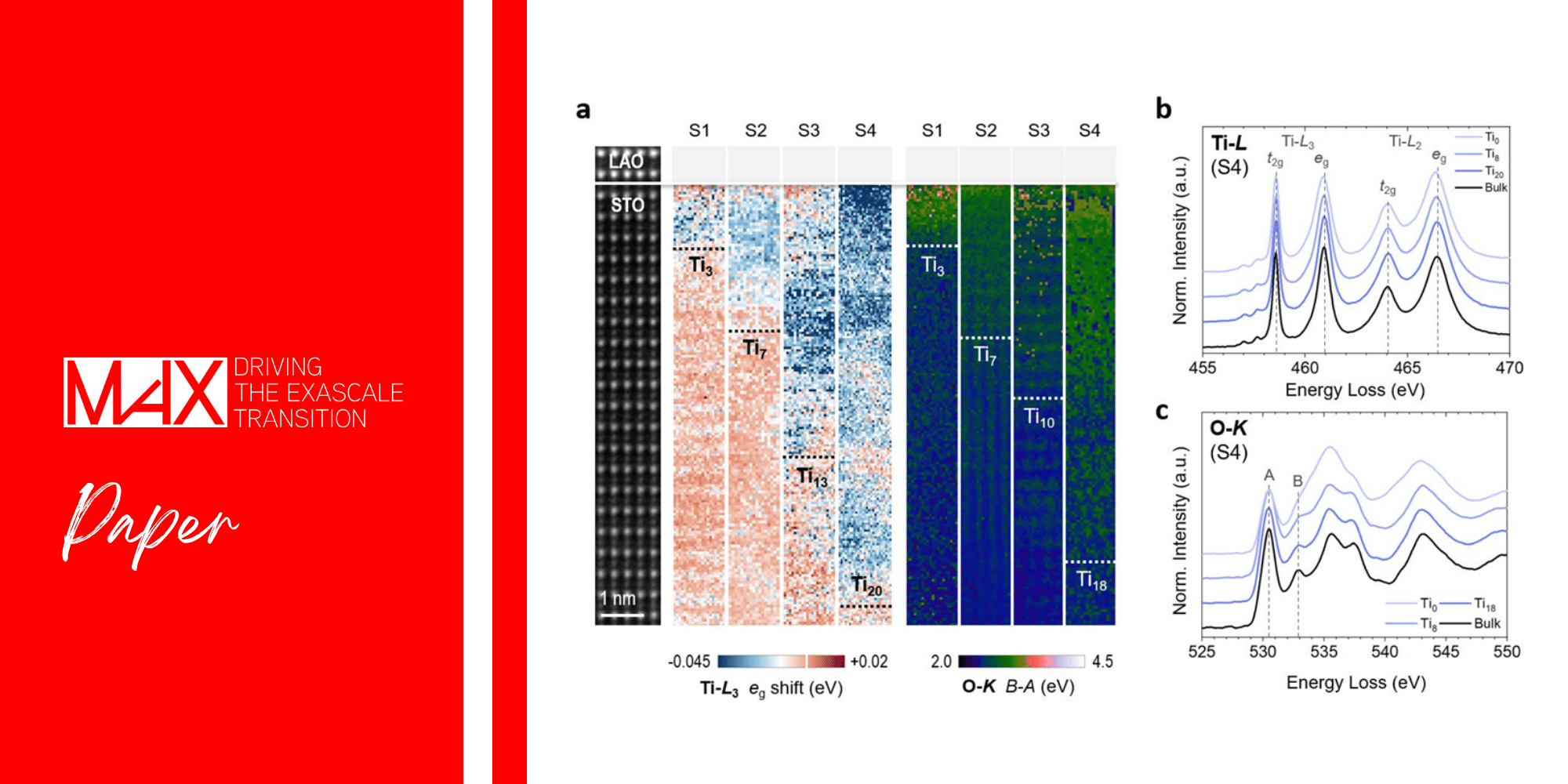
Electron–phonon coupling and symmetry breaking in superconducting oxide interfaces

14 September 2026

Researchers reveal how inversion symmetry breaking and tunable localized polar phonons correlate with superconductivity, providing evidence that lattice dynamics and strong electron–phonon coupling may contribute
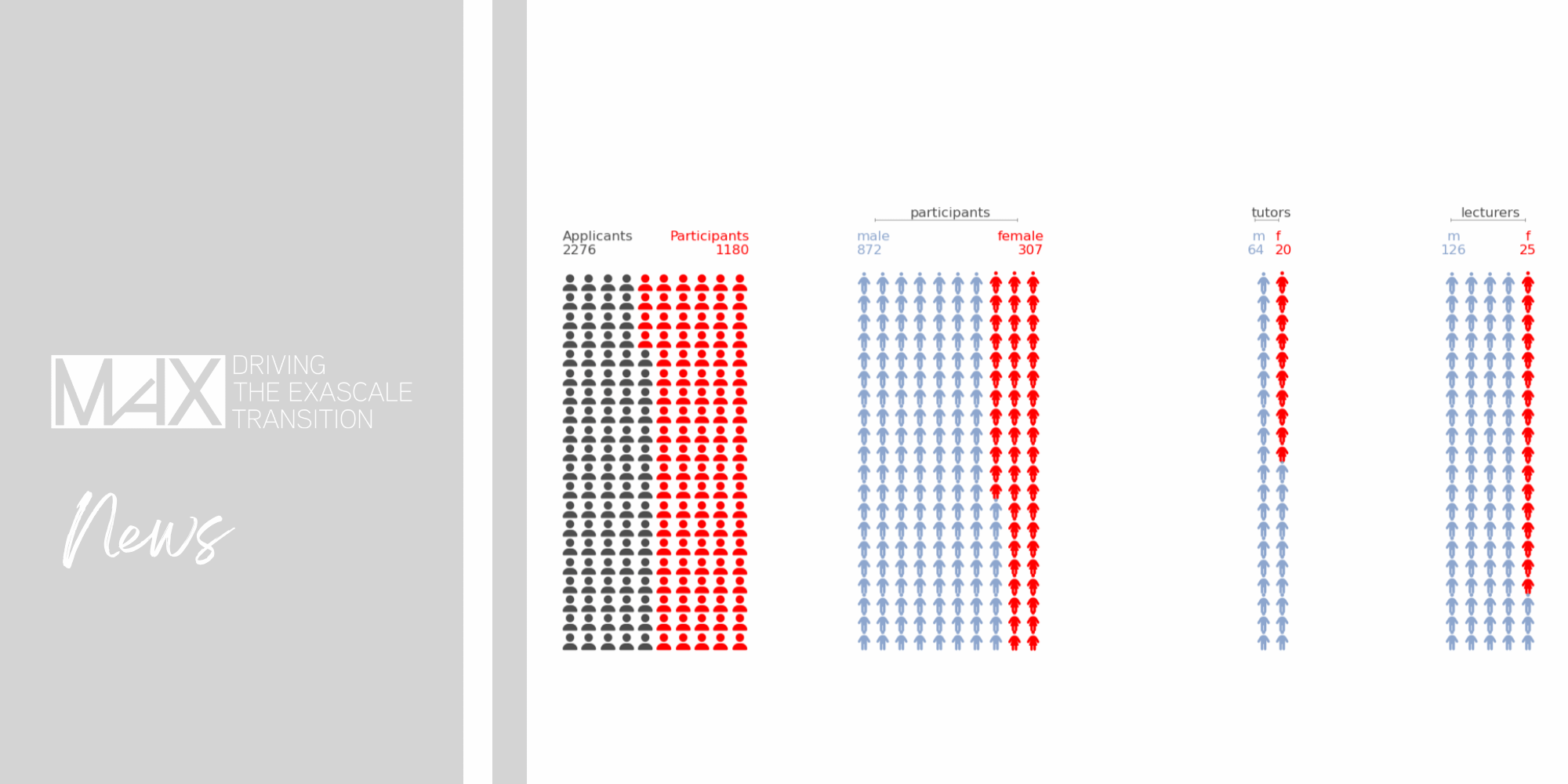
MaX training impact: expanding expertise, participation and collaboration in computational research

10 September 2026

Between 2023 and 2026, MaX training activities reached more than 1,100 researchers worldwide, combining in-person courses, online sessions and hackathons to foster expertise in advanced

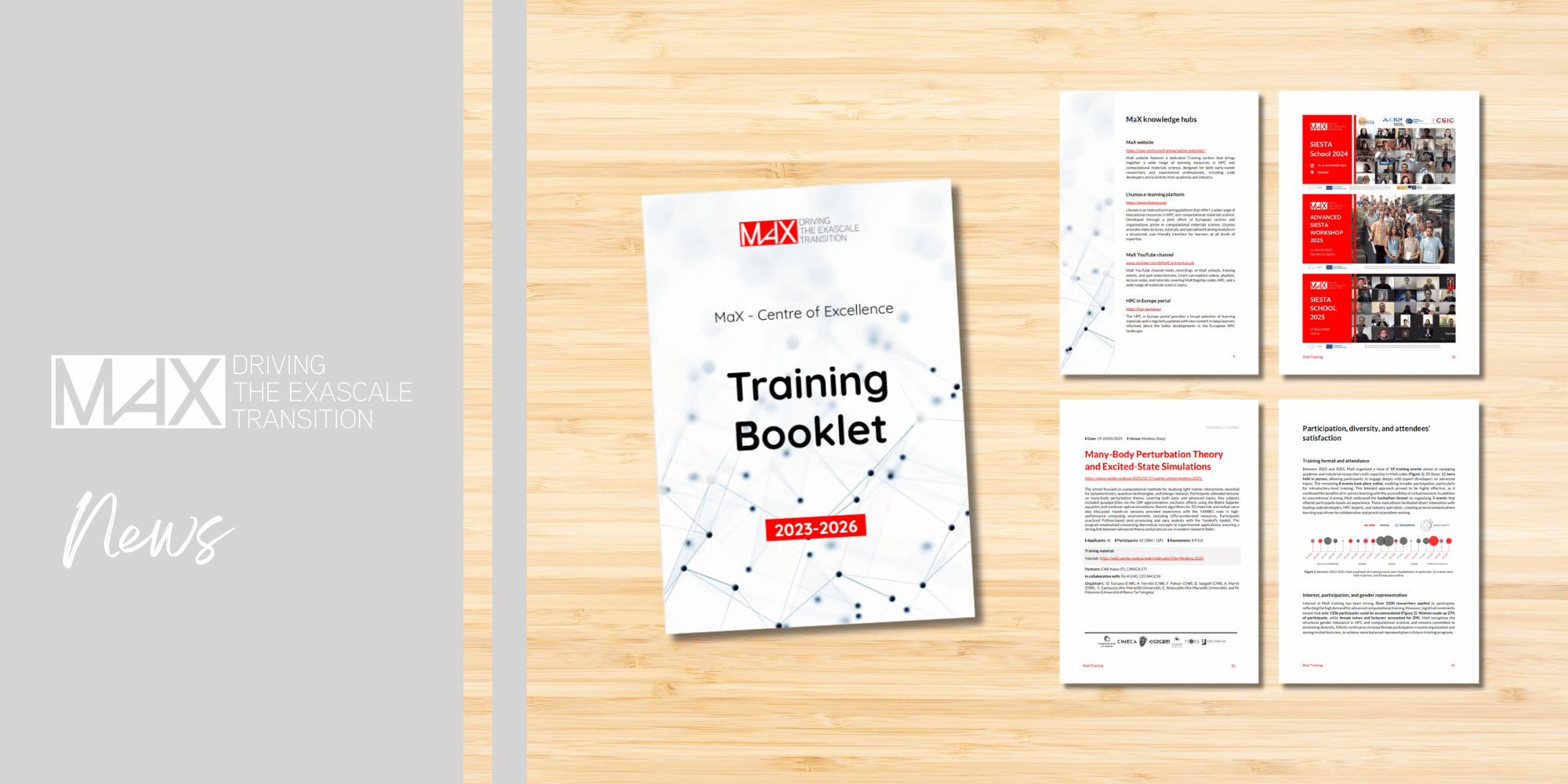
MaX updates its Training Booklet with activities from 2023–2026

9 September 2026

MaX has published a new edition of its Training Booklet, now extended to cover the period 2023–2026. The updated publication includes the most recent MaX

EuroHPC User Days event poster with dates September 22-24, 2026, in Dublin, Ireland, and the MaX logo.

MaX joins EuroHPC User Days 2026 in Dublin

8 September 2026

MaX will participate in the EuroHPC User Days 2026, taking place in Dublin, Ireland, from 22 to 24 September 2026. The event will bring together

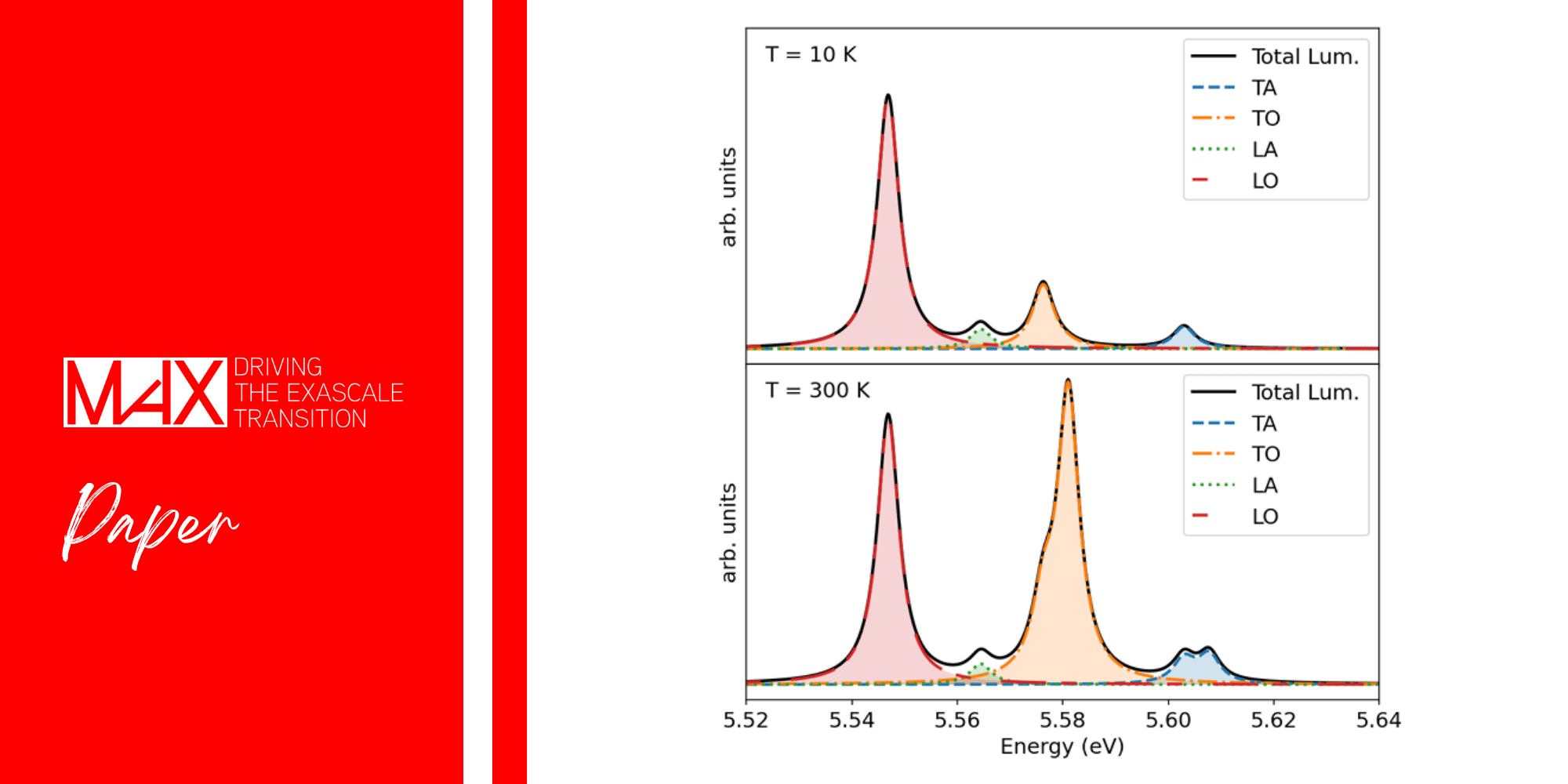
Phonon-assisted optical processes in cubic boron nitride

4 September 2026

First-principles many-body calculations show that phonon-mediated transitions are essential to describe light absorption and emission in cubic boron nitride, providing a more consistent interpretation of

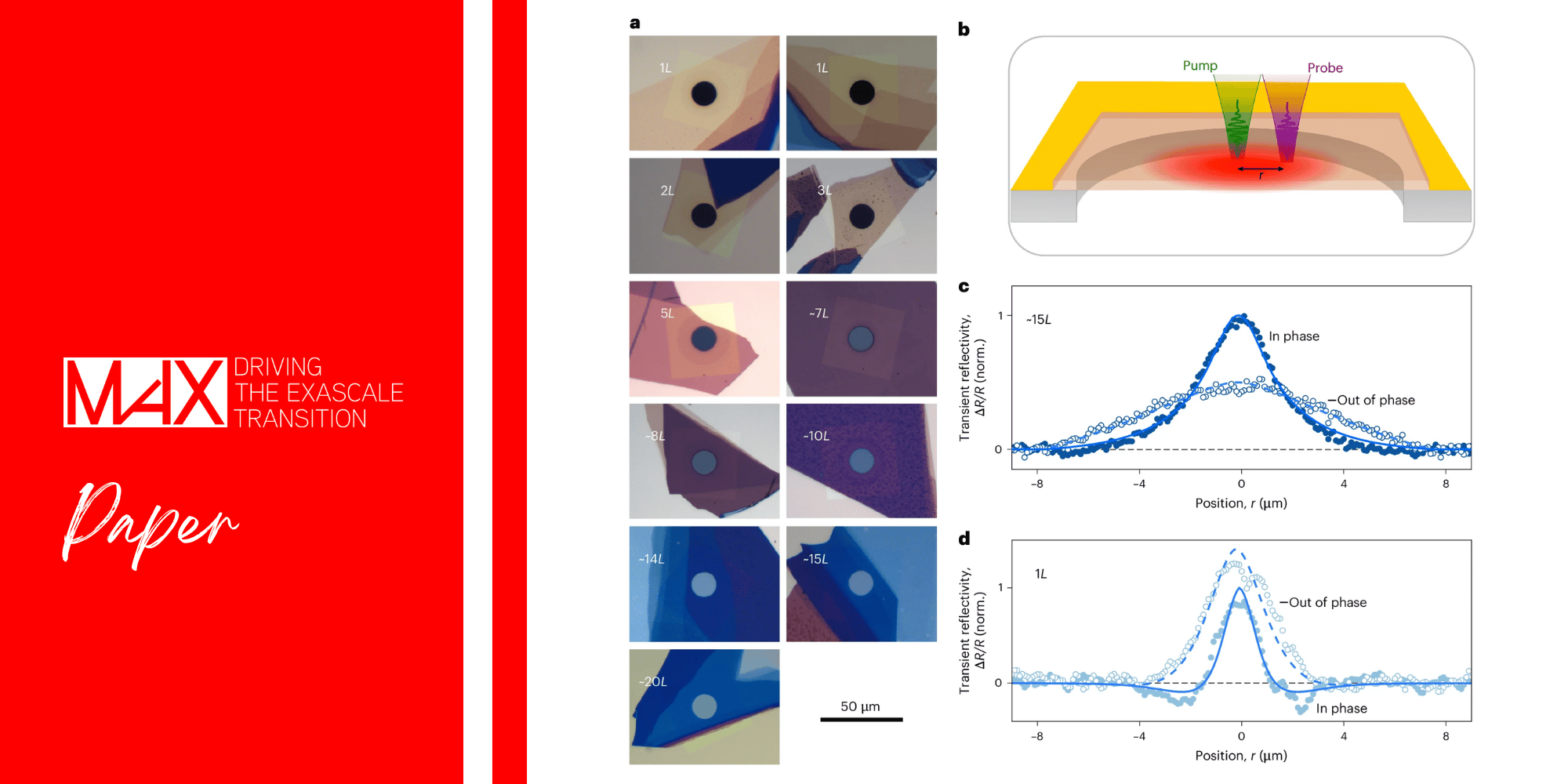
Controlling heat flow in ultrathin semiconductors at room temperature

18 August 2026

MaX researchers have identified a room-temperature heat-transport regime in ultrathin semiconductors, where hydrodynamic phonon flow and thermoelastic effects combine to reduce thermal diffusivity. The findings

Unveiling the nonequilibrium dynamics of high-energy excitations in monolayer WSe₂

8 August 2026

Researchers from MaX partner institutions combine ultrafast spectroscopy and first-principles simulations to uncover the delayed formation of high-energy excitonic states in monolayer WSe₂, revealing new

Choosing the right solver for MaX codes on modern HPC systems

23 July 2026

Application sectors: High-performance computing and EuroHPC services, Advanced materials modelling, Scientific software optimisation. Keywords: linear algebra, eigenvalue solvers, ScaLAPACK, cuSOLVER, cuSOLVERMp, ELPA, Yambo, EuroHPC, MaX,

MaX improves GPU efficiency with Multi-Process Service optimisation

22 July 2026

Application sectors: High-performance computing and EuroHPC services, Advanced materials modelling, Energy-efficient scientific computing. Keywords: Multi-Process Service, MPS, Quantum ESPRESSO, PHonon, SIESTA, YAMBO, GPU optimisation, Leonardo

graphene, graphene nanoribbons, edge reconstruction, topological defects, density functional theory, kinetic modelling.

Can graphene’s zigzag edges fully reconstruct? Simulations reveal the conditions

20 July 2026

Application sectors: Nanoelectronics and electronic interconnects, Graphene-based chemical sensing, Low-friction materials and tribology. Keywords: graphene, graphene nanoribbons, edge reconstruction, topological defects, density functional theory, kinetic

MaX strengthens the resilience of the Materials Cloud Archive

19 July 2026

Application sectors: Open science and FAIR research data, Computational materials science, European HPC and cloud infrastructure. Keywords: Materials Cloud Archive, FAIR data, CSCS, InvenioRDM, Ada

Benchmarking the Plasmon-Pole and Multipole Approximations in the Yambo Code Using the GW100 Data Set

18 July 2026

A new benchmark of the YAMBO code against the GW100 molecular data set shows that both its plasmon-pole and multipole approaches achieve strong agreement with reference

« Previous Page1 Page2 Page3 … Page24 Next »
MaX Centre of Excellence

c/o CNR NANO
via Campi 213A
I-41125 Modena

  • +39 059 2055629
  • email: info@max-centre.eu
Connect with us
  • Privacy Policy
  • Terms and Conditions
Logos of the European Union and the EuroHPC JU.

MaX – Materials design at the eXascale has received funding from the European High Performance Computing Joint Undertaking and Participating Countries in Project (Czechia, France, Germany, Italy, Slovenia, and Spain) under grant agreement no. 101093374.

Views and opinions expressed are however those of the author(s) only and do not necessarily reflect those of the European High Performance Computing Joint Undertaking. Neither the European Union nor the granting authority can be held responsible for them.

© Copyright

2026
Manage Consent
To provide the best experiences, we use technologies like cookies to store and/or access device information. Consenting to these technologies will allow us to process data such as browsing behavior or unique IDs on this site. Not consenting or withdrawing consent, may adversely affect certain features and functions.
Functional Always active
The technical storage or access is strictly necessary for the legitimate purpose of enabling the use of a specific service explicitly requested by the subscriber or user, or for the sole purpose of carrying out the transmission of a communication over an electronic communications network.
Preferences
The technical storage or access is necessary for the legitimate purpose of storing preferences that are not requested by the subscriber or user.
Statistics
The technical storage or access that is used exclusively for statistical purposes. The technical storage or access that is used exclusively for anonymous statistical purposes. Without a subpoena, voluntary compliance on the part of your Internet Service Provider, or additional records from a third party, information stored or retrieved for this purpose alone cannot usually be used to identify you.
Marketing
The technical storage or access is required to create user profiles to send advertising, or to track the user on a website or across several websites for similar marketing purposes.
  • Manage options
  • Manage services
  • Manage {vendor_count} vendors
  • Read more about these purposes
View preferences
  • {title}
  • {title}
  • {title}