
MaX researchers have identified a room-temperature heat-transport regime in ultrathin semiconductors, where hydrodynamic phonon flow and thermoelastic effects combine to reduce thermal diffusivity. The findings offer an intrinsic route to controlling heat flow in two-dimensional materials without additional fabrication during operation.
Application sectors: Semiconductor and microelectronics industry, Advanced materials and nanotechnology, Photonics and optoelectronics.
Keyword: Hydro-thermoelastic transport; thermal transport; two-dimensional semiconductors; MoS₂; MoSe₂; phonon hydrodynamics; thermoelasticity; thermal management; atomistic modelling; ab initio calculations.
Heat transport in ultrathin semiconductors does not always follow the rules expected from conventional diffusion. In MoSe₂ and MoS₂, researchers have now shown that hydrodynamic phonon flow and thermoelastic effects can combine to produce a distinct room-temperature transport regime, in which heat propagation can be strongly reduced and actively controlled.
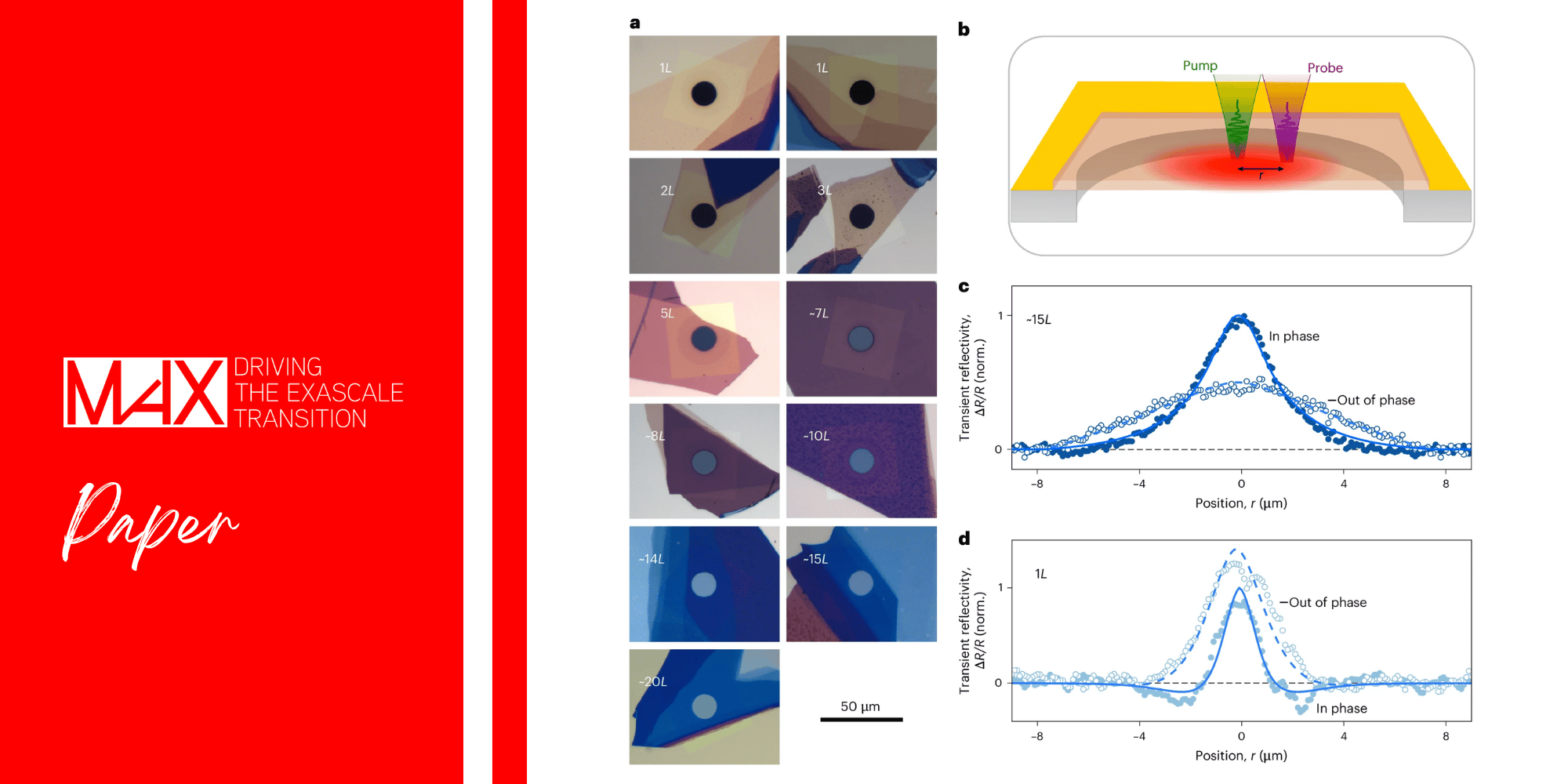
Using spatiotemporal pump–probe thermometry, the team tracked heat in real space with nanometre accuracy and observed a thickness-dependent transition from Fourier diffusion to strongly non-diffusive transport. A mesoscopic model based on ab initio parameters reproduced the measurements and revealed a thermoelastic heat flux that can run from colder to hotter regions, reducing effective thermal conductivity by up to an order of magnitude in MoSe₂.
The study includes researchers from MaX partner ICN2, together with colleagues from Eindhoven University of Technology, Universitat Autònoma de Barcelona, McGill University, Technische Universität Berlin, and the University of Colorado Boulder and NIST. By linking atomistic modelling with nanoscale thermometry, the work opens a fabrication-free route to active thermal control in two-dimensional semiconductors under practical, experimentally accessible room-temperature operating conditions.
Reference paper
S. Varghese, J. Tur-Prats, J. D. Mehew, D. Saleta Reig, R. Farris, J. Camacho, J. A. Haibeh, A. Sokolov, P. Ordejón, S. Huberman, A. Beardo, F. X. Alvarez & K. J. Tielrooij, “Controllable hydro-thermoelastic heat transport in ultrathin semiconductors at room temperature”, Nature Physics 22, 1057–1063 (2026). DOI: 10.1038/s41567-026-03297-1.