
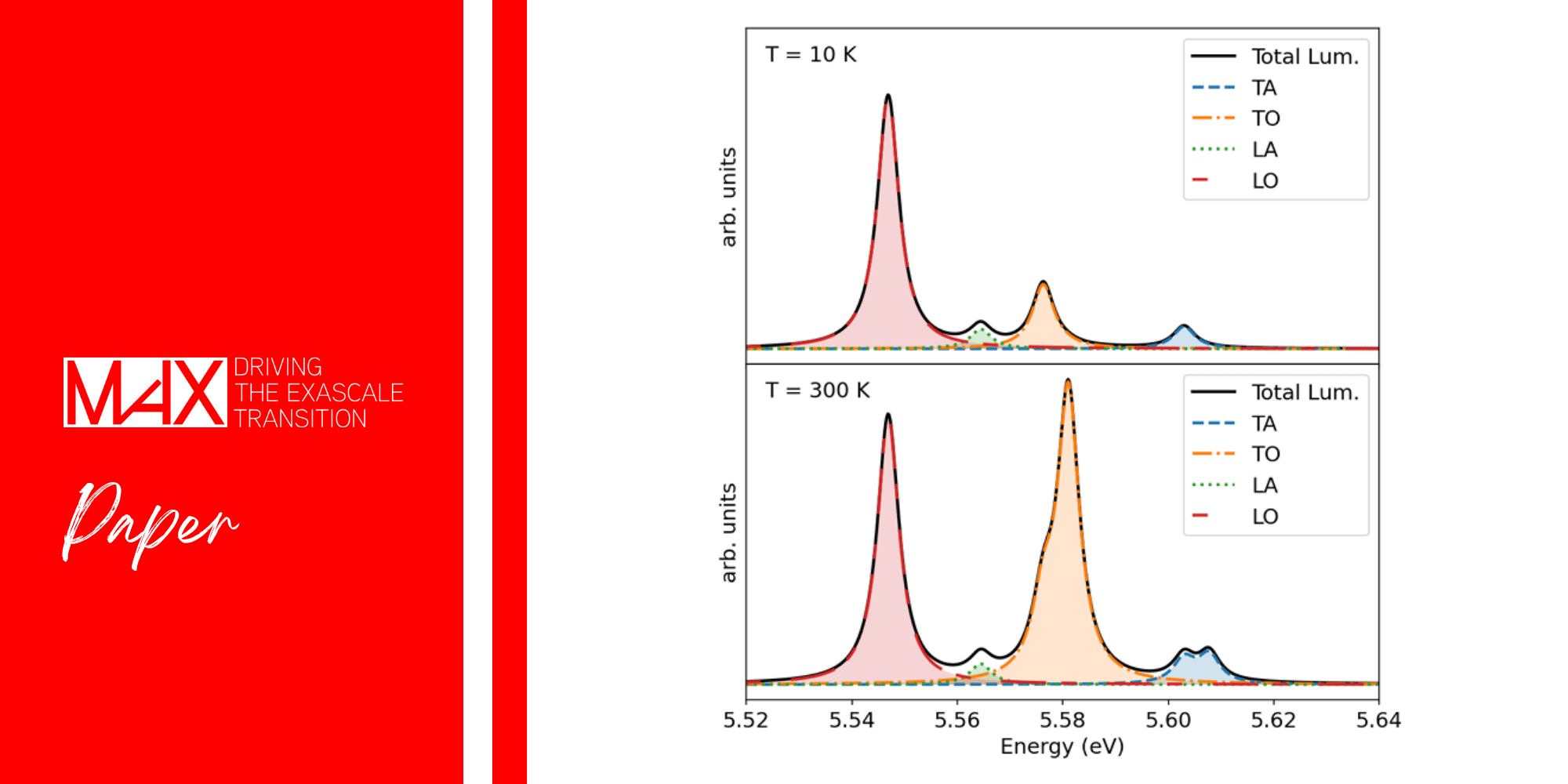
First-principles many-body calculations show that phonon-mediated transitions are essential to describe light absorption and emission in cubic boron nitride, providing a more consistent interpretation of its wide-bandgap optical response and experimental luminescence spectra.
Application sectors: UV optoelectronics and deep-UV light sources. Wide-bandgap semiconductor materials and device engineering, UV photodetectors and optical sensing.
Keywords: Cubic boron nitride, Exciton–phonon coupling, Many-body perturbation theory, Phonon-assisted optical transitions, Wide-bandgap materials.
Cubic boron nitride (cBN) is a wide-bandgap material whose optical response is influenced by indirect electronic transitions and strong exciton–phonon coupling. In their study published in Applied Physics Letters, A. Pillai and co-authors use first-principles Many-Body Perturbation Theory, combining GW quasiparticle corrections, Bethe–Salpeter equation calculations and explicit exciton–phonon coupling to investigate cBN optical properties.
The results show that phonon-mediated transitions provide a dominant contribution to both absorption and luminescence. Including these processes helps reconcile the theoretical optical gap with experimental emission observed around 6–7 eV, demonstrating that lattice vibrations are essential for interpreting the optical spectra of cBN.
The work provides a more complete theoretical framework for wide-bandgap materials with indirect transitions and strong electron–phonon interactions. These results are particularly relevant to the development and modelling of deep-UV optoelectronic materials, while also supporting the interpretation of spectroscopic measurements and the assessment of cBN for UV-sensitive applications.
Reference paper
- Pillai, E. Cannuccia, A. Manchon, F. Paleari, and C. Attaccalite, “Phonon-assisted light absorption and emission in cubic boron nitride,” Applied Physics Letters 128, 161902 (2026), published 20 April 2026. DOI: 10.1063/5.0332006