
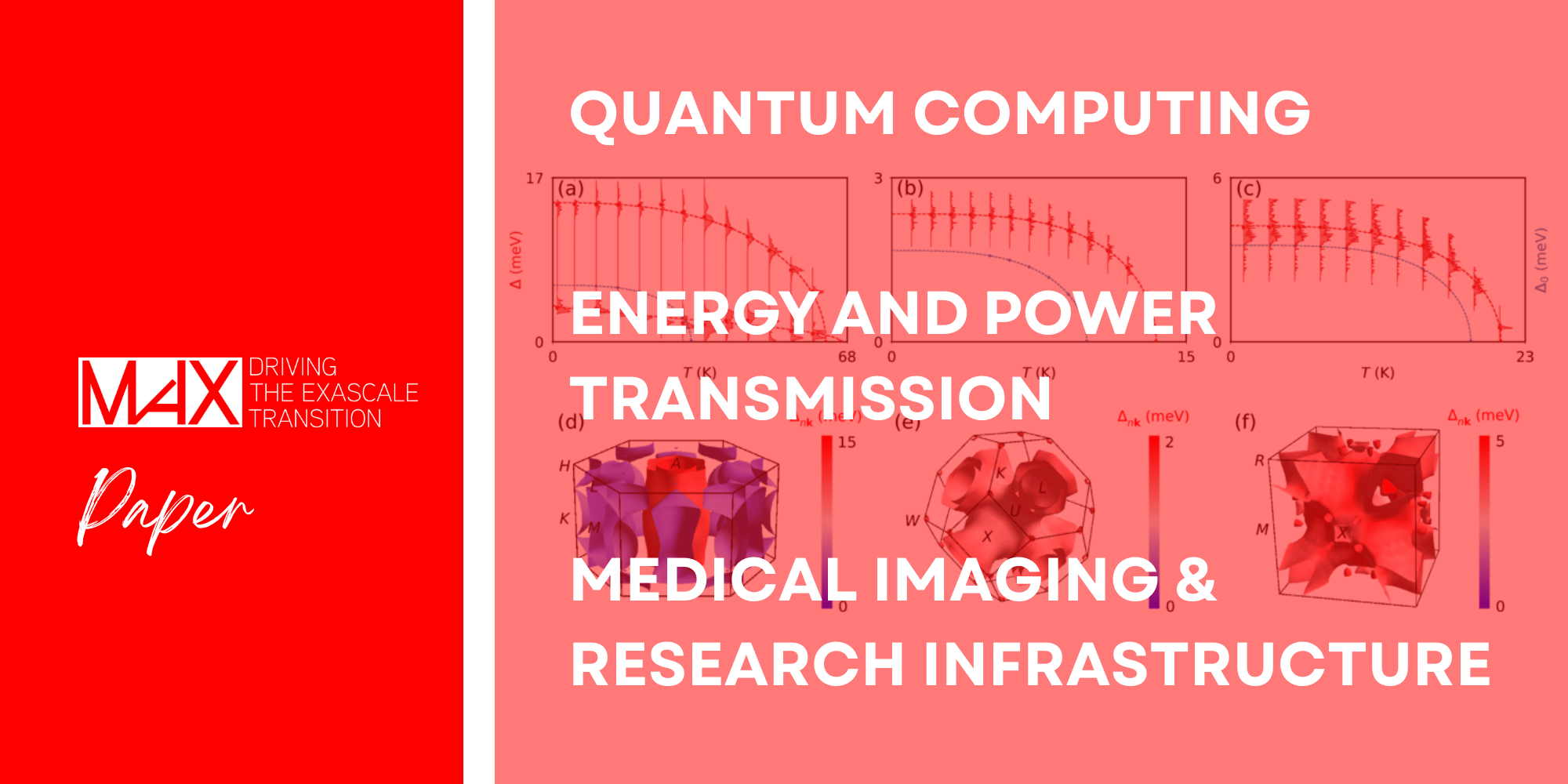
Application sectors: Quantum computing, Energy and power transmission, Medical imaging and research infrastructure
Keywords: superconductivity, high-throughput, electron-phonon, HPC, materials discovery
Superconductors underpin transformative technologies such as MRI machines, maglev trains, and particle accelerators. While high-temperature superconductors exist, most practical applications still rely on conventional Nb-Ti alloys and A15 compounds, whose properties are well-described by Bardeen-Cooper-Schrieffer (BCS) theory. Discovering new, robust superconductors has been historically slow, with only one new stoichiometric BCS superconductor found per year on average over the past century. In this study, a team of researchers performed a large-scale computational search across 4533 experimentally known nonmagnetic metals from the Materials Cloud 3D database. Using high-precision electron-phonon calculations, the researchers identified 250 dynamically stable candidates, computed isotropic and anisotropic Migdal-Eliashberg superconducting gaps, and predicted critical temperatures. Among these, 82 matched known superconductors with 90% accuracy, validating the approach. Notably, 24 previously unreported materials were predicted to have critical temperatures above 10K, including the double-gap superconductor hole-doped BaB2 (~62K), the half-Heusler ZrRuSb (11K), and the perovskite TaRu3C (25K). These findings highlight the potential of high-throughput ab initio methods to uncover overlooked superconductors with practical application potential.
Method
The researchers combined density functional theory (DFT), density-functional perturbation theory (DFPT), and electron-phonon calculations using the QUANTUM ESPRESSO, WANNIER90, and EPW codes. High-throughput screening involved progressively denser momentum-space sampling to calculate the Eliashberg spectral function and Allen-Dynes critical temperatures, followed by automated Wannierization for accurate band interpolation.
HPC resources were essential to handle the computational intensity of 4533 candidate materials, including convergence of ultra-dense Brillouin-zone grids, relaxation of dynamically stable structures, and anisotropic superconducting gap calculations.
Combined with automated workflows through AiiDA, the pipeline allowed systematic, reproducible, and large-scale predictions that would be infeasible manually. Technologically, this approach provides a blueprint for reliable, automated discovery of novel phonon-mediated superconductors from existing experimental databases.
Implications
This work demonstrates that high-throughput HPC simulations can reliably identify new BCS superconductors, even among well-studied materials. The discovery of double-gap, half-Heusler, and perovskite superconductors opens pathways for experimental validation and potential application in quantum computing, energy transmission, and advanced imaging technologies. The sensitivity analysis further ensures robustness of predictions against small doping variations, increasing confidence in experimental realization.
Looking forward, these results highlight the importance of HPC-enabled materials discovery for both academic research and industrial innovation. Expanding the workflow to larger unit cells or improved Wannierization could uncover additional hidden superconductors.
Contact the MaX team to implement high-throughput workflows for your materials research.
Data
The data that support the findings of this paper are openly available: Materials Cloud archive, 2025, https://archive. materialscloud.org/record/2025.39, accessed: 2025-03-13.
Reference paper
Charting the Landscape of Bardeen-Cooper-Schrieffer Superconductors in Experimentally Known Compounds, M. Bercx, S. Poncé, Y. Zhang, G. Trezza, A. Ghorbani Ghezeljehmeidan, L. Bastonero, J. Qiao, F. O. von Rohr, G. Pizzi, E. Chiavazzo, and N. Marzari PRX Energy 4, 033012 (2025), https://doi.org/10.1103/sb28-fjc9.