
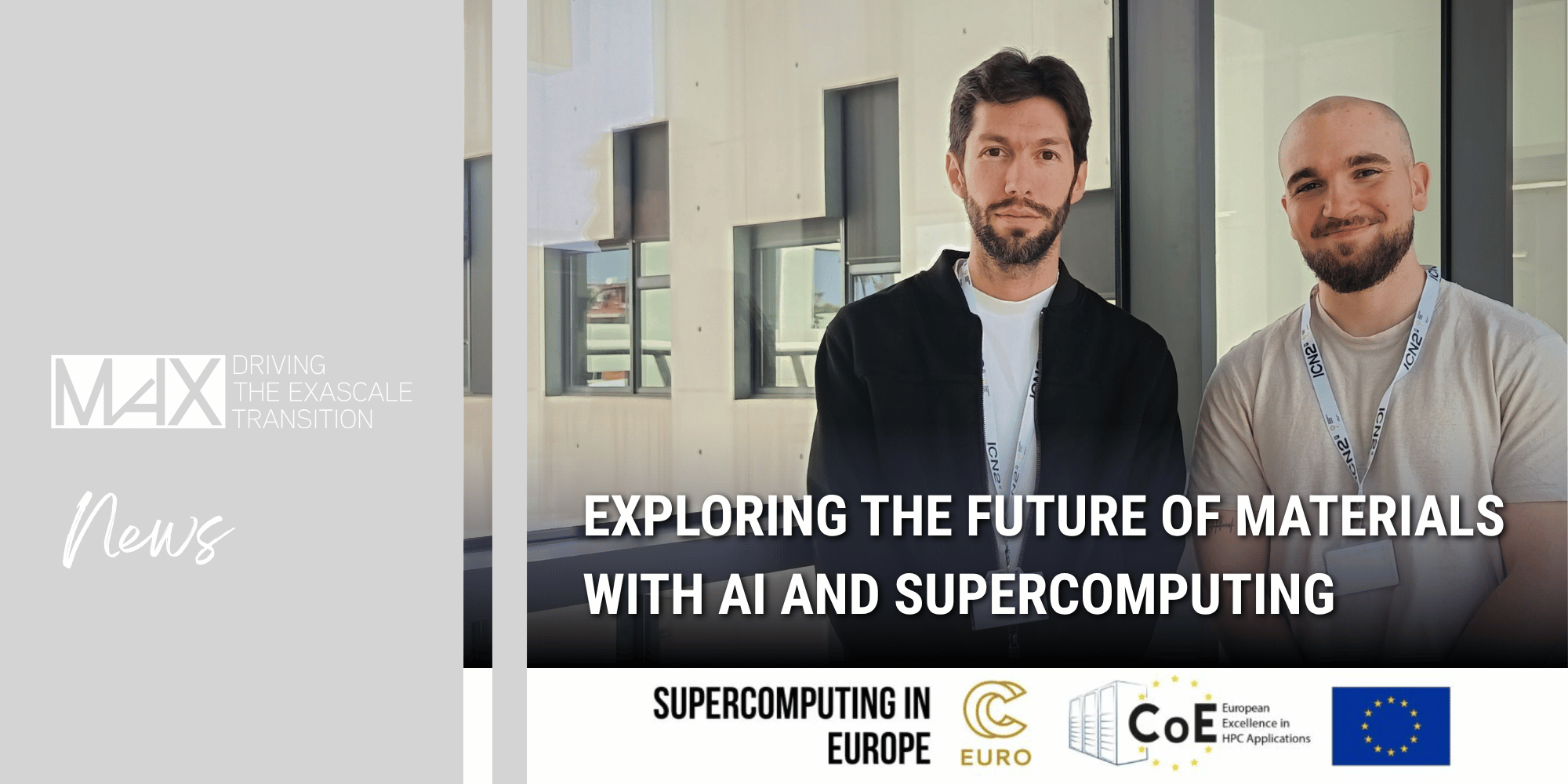
In the latest episode of the EuroCC Supercomputing in Europe podcast, MaX member Marina Corradini speaks with Andrés Henao and Francisco Molina from ICN2 about the growing role of artificial intelligence, machine learning, and high-performance computing in materials discovery.
Artificial intelligence is changing the way scientific research is conducted. In materials science, the discovery and design of new materials have traditionally required years of laboratory experiments, simulations, and trial-and-error. Today, with the advent of AI, new possibilities have emerged for faster and more systematic research in the field. In a recent episode of the EuroCC Supercomputing in Europe podcast, MaX member Marina Corradini spoke with Andrés Henao and Francisco Molina from the Catalan Institute of Nanoscience and Nanotechnology in Barcelona, Spain, about the growing role of artificial intelligence, machine learning, and high-performance computing in materials discovery. The conversation explored how AI is redefining how scientists design experiments, analyse data, and explore new research paths. In particular, the discussion covered the importance of data management, and the challenges of making AI both reliable and sustainable.
AI is not new
As Andrés and Francisco explained, AI is not new, as the term itself dates back to the 1950s. Yet, it is only recently that AI’s role has permeated and expanded in scientific research thanks to major advances in data availability, large language models, and supercomputing resources. AI does not replace the scientific method but rather supports it by making research more efficient and structured. AI helps process large datasets, improve planning, and find solutions faster. By analysing complex datasets from experiments, simulations, images, and scientific literature, today AI can help researchers identify patterns and optimise workflows. In materials science, the so-called “AI agents” can even guide researchers toward the most promising experiments, reducing the time and resources needed for discovery.
Can AI truly discover something new?
A central question in AI-driven materials science is whether AI can genuinely discover something new if it is trained only on existing data. Most machine learning models are excellent at interpolation (that is, identifying patterns within scenarios similar to those already seen) but often struggle with extrapolation into new domains. In materials science, the chemical space is extraordinarily large. Even when researchers focus on a limited class of materials, the number of possible combinations remains enormous. AI cannot magically invent knowledge beyond its training data, but it can help researchers explore regions of this space that would otherwise remain inaccessible due to time or computational limitations. In practice, this means AI becomes a tool for guiding researchers toward better hypotheses and more promising directions.
The human challenge
Interestingly, the discussion revealed that one of the largest barriers to AI adoption is not technological, but rather cultural: many researchers are aware of AI but do not yet fully understand how it can support their work. The guests also acknowledged that there are areas where society may already rely too heavily on AI tools. Programming was mentioned as an example, where developers increasingly depend on large language models for coding assistance, sometimes without fully verifying the correctness of generated solutions. The key, they argued, is to use AI critically and responsibly rather than treating it as an infallible system.
A new scientific paradigm
The discussion with Andrés Henao and Francisco Molina highlighted a broader transformation taking place in all different areas of scientific research. AI is not replacing scientists, nor is it autonomously inventing materials without human guidance. Instead, it is becoming a powerful tool that helps researchers navigate increasingly complex datasets, accelerate discovery processes, and make better-informed decisions. Combined with high-performance computing, AI is opening new paths for materials design and nanotechnology research, while also raising important questions about sustainability, transparency, and responsible use. As scientific data continues to grow in scale and complexity, the collaboration between AI, supercomputing, and human expertise will likely become one of the defining elements of future research.
Listen to the full episode
Spotify | Supercomputing in Europe
The Supercomputing in Europe podcast is made possible with funding from , the joint initiative from the EU, European countries, and private partners to develop a world class HPC Ecosystem in Europe. The podcast is sustained by the EuroCC project, the AI Factories and the Centres of Excellence network that provides supercomputing and AI support for industry, academia and public administration. Learn more at HPC in Europe Portal.