
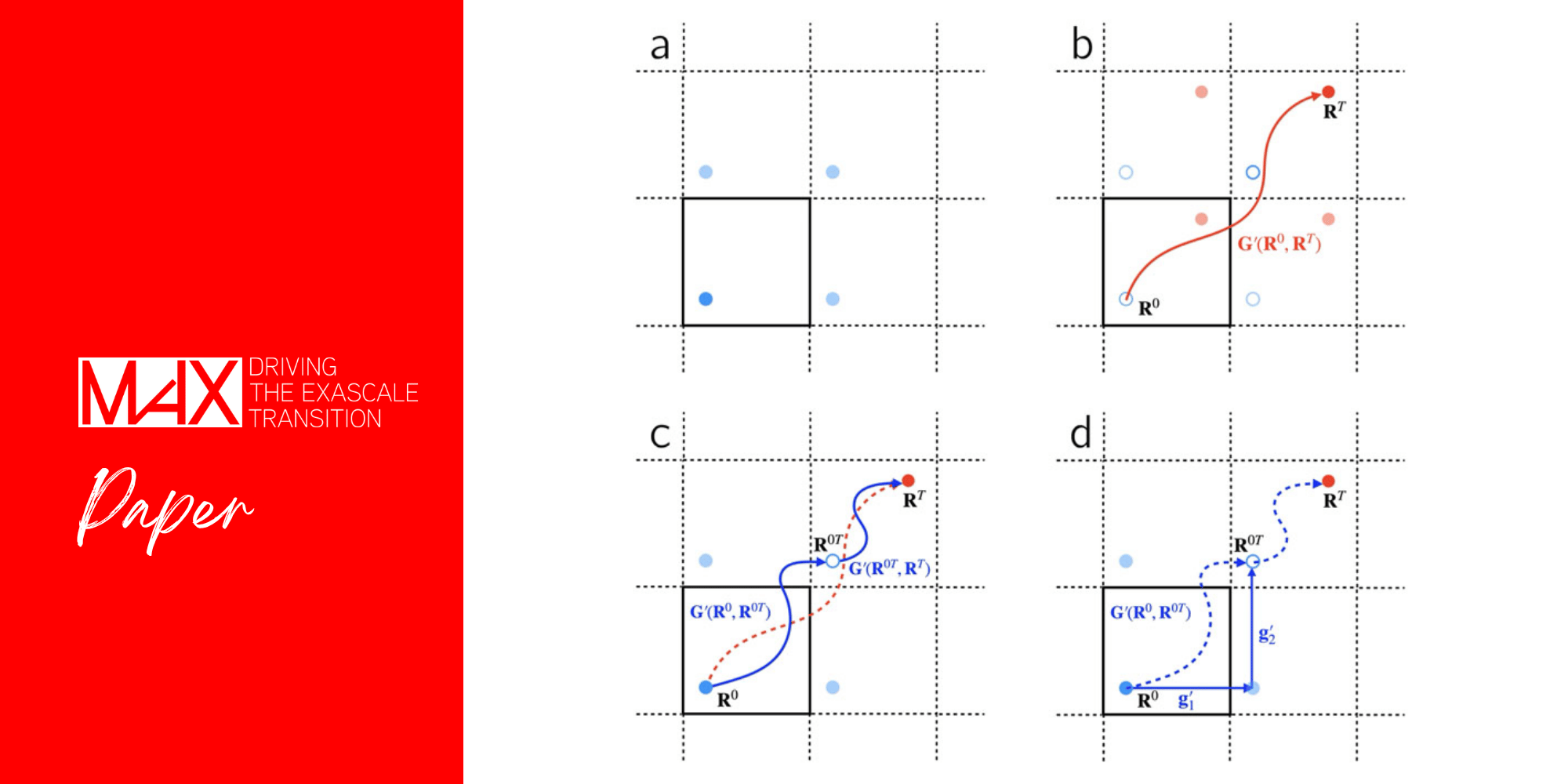
A recent paper by Stefano Baroni, published in Journal of Chemical Physics, provides a general theoretical proof of gauge invariance in thermal transport.
Thermal conductivity is typically computed from microscopic energy fluxes, which depend on how energy is locally defined. Since this definition is not unique, it has long posed a conceptual challenge for atomistic simulations.
This study demonstrates, in the most general terms, that thermal conductivity is independent of the specific choice of energy density. It establishes the minimal conditions under which different energy representations, whether continuous or atomistic, lead to the same transport coefficients within the Green–Kubo framework.
Importantly, the work introduces the concept of convective invariance, showing that energy fluxes differing by convective terms (linked to mass transport) yield identical thermal conductivity. This extends previous assumptions and places the theory on firmer ground.
The findings are particularly relevant for machine-learning-based simulations, where different energy decompositions are commonly used. The results confirm that such choices do not affect computed thermal conductivity, reinforcing confidence in modern computational approaches.
Reference paper
The nuts and bolts of gauge invariance of heat transport, S. Baroni, Journal: J Chem Phys 164(1):014104 (2026). https://doi.org/10.1063/5.0304329.