
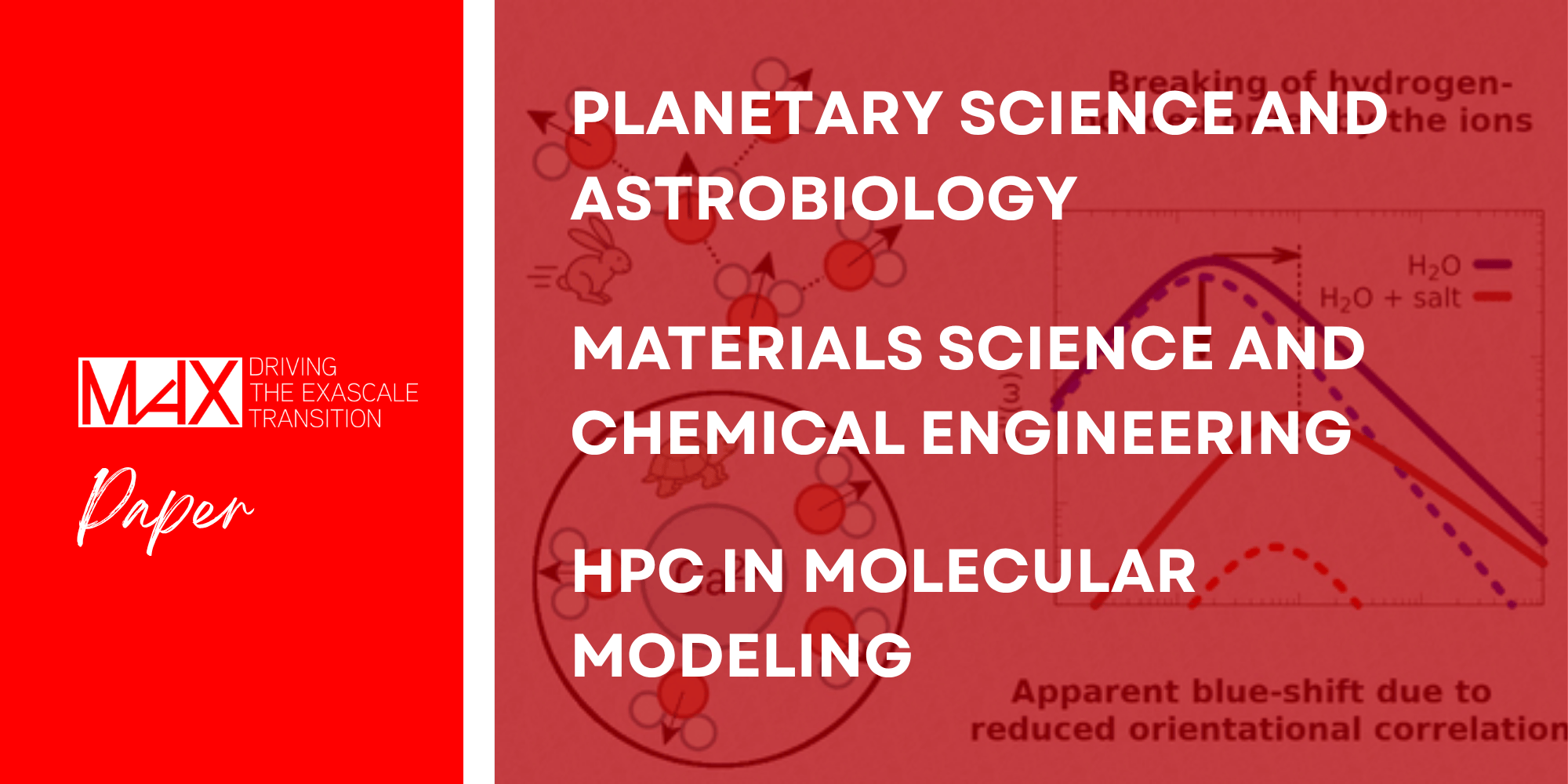
Understanding how solvated ions alter water’s molecular behaviour and dielectric response, with implications from planetary science to materials engineering.
Application sectors: Planetary science and astrobiology, Materials science and chemical engineering, High-performance computing in molecular modeling.
Keywords: water dynamics, dielectric spectrum, ionic solvation, HPC simulations, neural network potentials.
Water’s interaction with dissolved salts is fundamental to both everyday life and advanced science, yet its microscopic mechanisms remain partially elusive. Specifically, the addition of salts reduces water’s static dielectric constant while shifting the dielectric absorption peak to higher frequencies. Paradoxically, this implies faster molecular dynamics, conflicting with experimental evidence showing that ions slow down local water motion and increase viscosity.
Using molecular dynamics simulations informed by deep neural networks trained on high-accuracy quantum mechanical data, the study reveals that both effects are manifestations of the same underlying mechanism: the disruption of orientational correlations among water molecules near cations. The Kirkwood correlation factor, gK, decreases with salt concentration, reducing the collective alignment of dipoles and lowering the static dielectric constant. At the same time, a high-frequency shift in the dielectric-loss peak arises from the same ionic effect, while a distinct low-frequency peak emerges in the first hydration shell, reflecting slower local water dynamics. This work resolves the longstanding puzzle of seemingly contradictory dielectric behaviour in saline water and highlights the dominant role of ion-induced orientational changes.
Implications
The study establishes that the reduction of water’s dielectric constant and the high-frequency shift of the absorption peak are both consequences of diminished orientational correlations caused by solvated cations. Simultaneously, local water molecules in the first solvation shell experience slowed rotational dynamics, aligning with increased viscosity observations. These findings resolve a century-old debate and provide a rigorous microscopic explanation for the dielectric behaviour of saline water.
Beyond fundamental understanding, this work has practical implications for interpreting radar and dielectric measurements of briny water on Mars, improving predictive models in materials science, and informing industrial processes involving saline solutions. Future research can extend these simulations to Martian temperatures and explore thermal transport properties under extreme conditions.
Explore the neural network potentials, simulation workflows, and datasets via the MaX CoE software ecosystem, and talk to us about applying HPC-driven molecular modeling to your research challenges.
Reference paper
How Salt Solvation Slows Water Dynamics While Blue-Shifting Its Dielectric Spectrum, F. Pabst and S. Baroni, Journal of Physical Chemistry Letters, 16 (31), 7915 – 7920 (2025). https://doi.org/10.1021/acs.jpclett.5c01401.