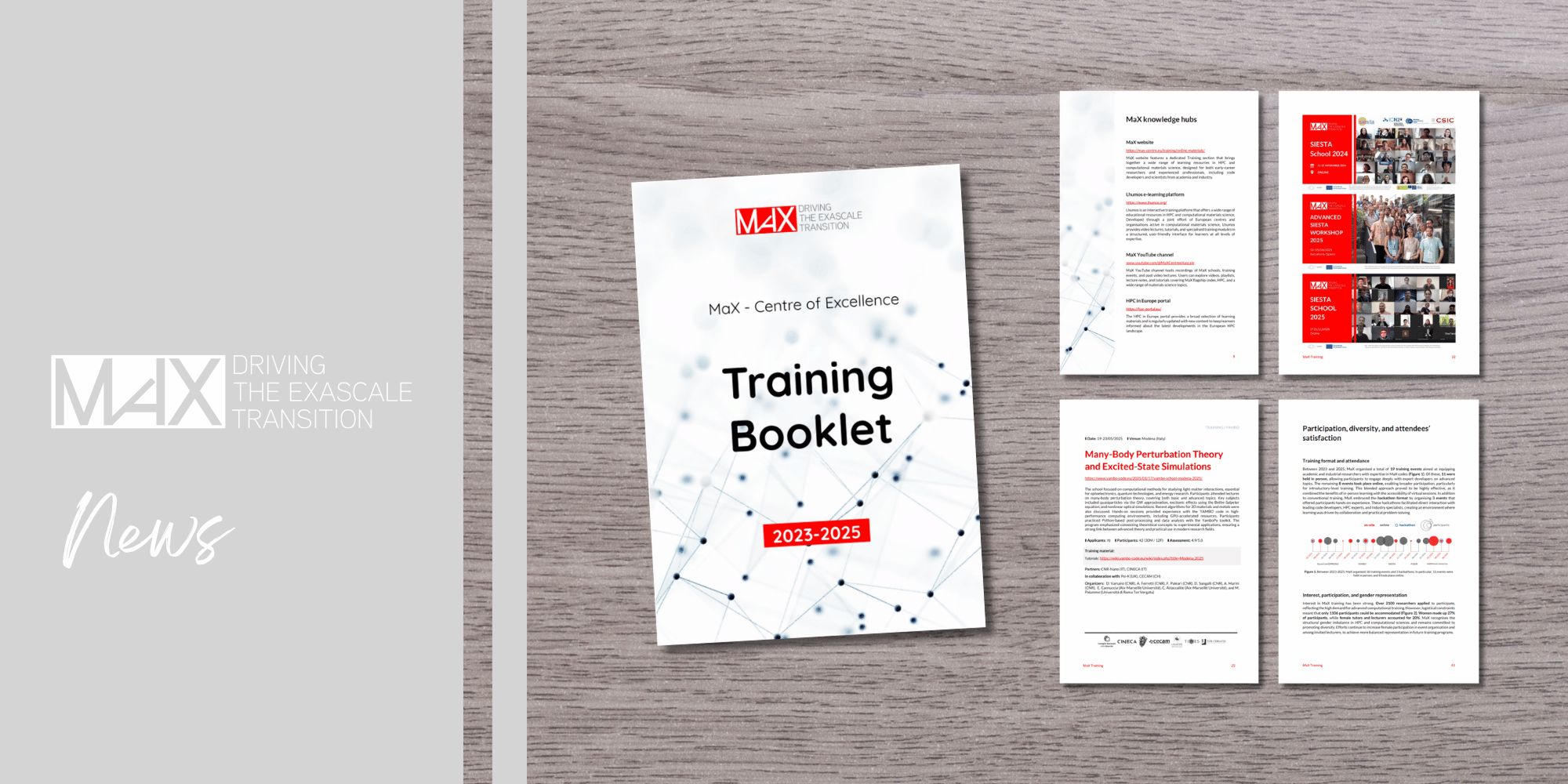
MaX has released its Training Booklet, summarising the education and training activities organised between 2023 and 2025. The booklet provides an overview of how MaX has supported academic and industrial professionals in building expertise in high-performance computing and computational materials science over the course of the project.
As supercomputers reach exascale capabilities, the demand for sophisticated simulation tools in materials research is increasing. MaX addresses this challenge by developing and maintaining a suite of open-source codes that allow scientists to study materials at unprecedented levels of accuracy.
MaX lighthouse codes (Quantum ESPRESSO, YAMBO, SIESTA, BigDFT, and FLEUR) form an interoperable ecosystem for large-scale simulations of electronic, magnetic, and optical properties. Behind each software release stands a dedicated community of developers and researchers, continuously working to improve performance, scalability, and interoperability in preparation for the exascale era.
Experience has shown that software alone is never sufficient. Progress in computational materials science also depends on how knowledge is shared, how skills are developed, and how new generations of researchers are supported. This principle has guided MaX from the very beginning. Alongside software development, MaX has made a sustained investment in people, providing opportunities for researchers at all stages of their careers to grow their expertise. Training has become a natural and essential part of this mission, and the MaX Training Booklet shows how this approach has been translated into action.
Between 2023 and 2025, MaX organised 19 training events, including 16 courses and workshops and 3 hackathons. Eleven of these events were held in person, offering direct interaction with code developers and HPC experts, while eight were delivered online, broadening access for introductory-level participants. Hackathons added a practical, collaborative dimension, allowing participants to work alongside experts to tackle real-world scientific problems. Interest in these activities has been consistently strong. More than 2,100 researchers applied, and 1,106 participants were accommodated. The booklet also reports on participation data, including gender representation: women made up 27% of participants and 20% of tutors and lecturers. While structural imbalances remain, MaX continues to work toward more balanced representation in training and research.
The training programme is designed to meet the needs of learners at different career stages. Alongside workshops and schools, MaX provides e-learning resources, including webinars, recorded lectures, and open-access teaching materials. Internships and research placements in affiliated laboratories give participants the opportunity to apply their skills in real research settings, bridging the gap between theory and practice.
The MaX Training Booklet provides more than a record of past events. It reflects a broader commitment to building expertise, fostering collaboration, and supporting the next generation of computational materials scientists. For researchers, educators, and professionals, it serves as both a reference and an invitation: to explore, to learn, and to join a community working at the forefront of HPC and materials science.
Download the booklet: MaX Training Booklet