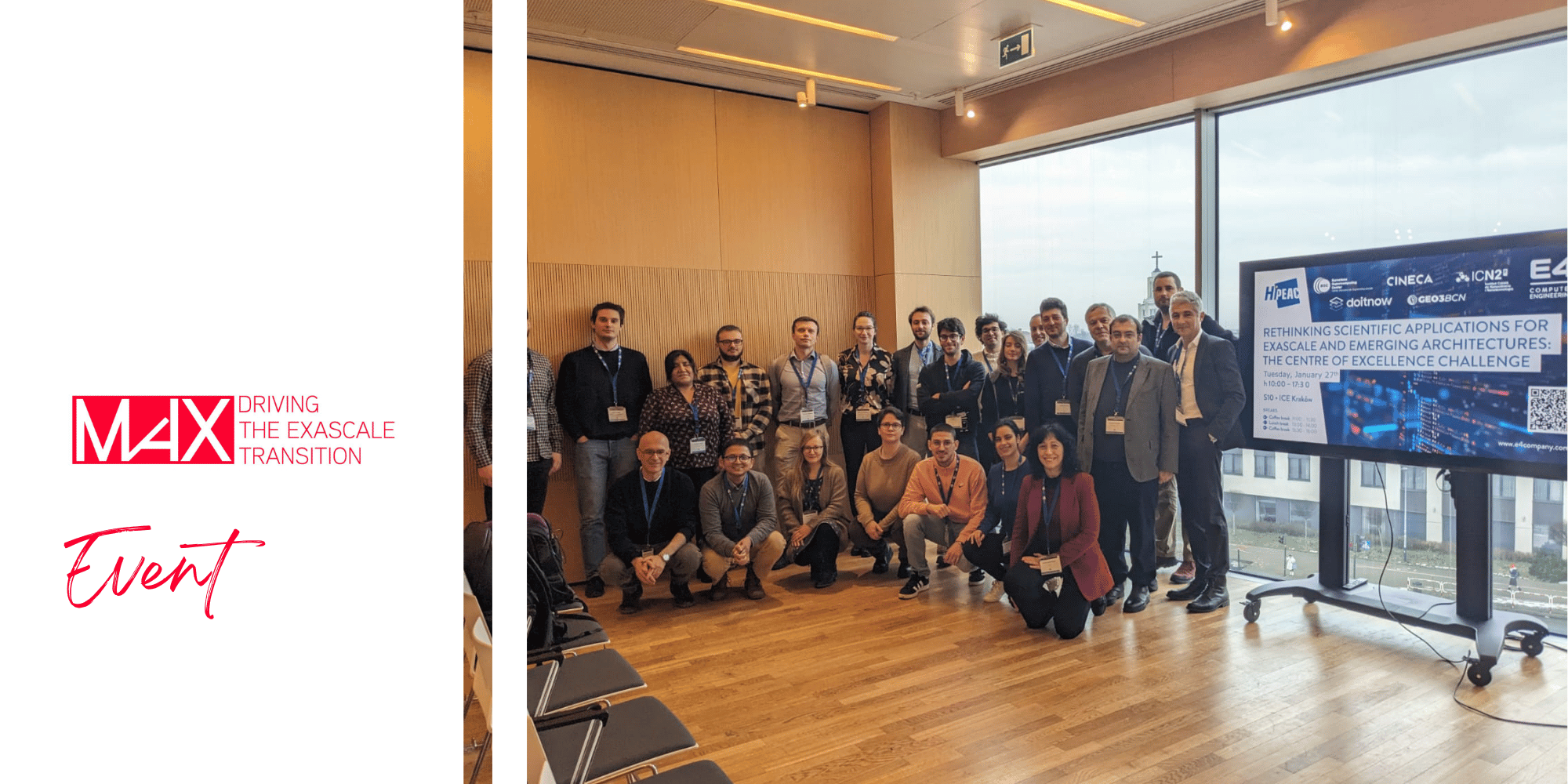
On January 27, 2026, researchers from European Centres of Excellence (CoEs) met in Krakow during HiPEAC 2026 for the workshop “Rethinking Scientific Applications for Exascale and Emerging Architectures: the Centre of Excellence challenge”. The meeting brought together experts in High Performance Computing and Quantum Computing to discuss how scientific software must change for future architectures.
The workshop continued a long dialogue among CoEs about the transition from petascale to exascale computing. Participants agreed that legacy scientific codes cannot simply be transferred to new machines. They must be redesigned to exploit heterogeneous architectures, accelerators, and complex memory hierarchies. This requires new algorithms, new workflows, and new approaches to software sustainability.
Materials Design Towards the Exascale
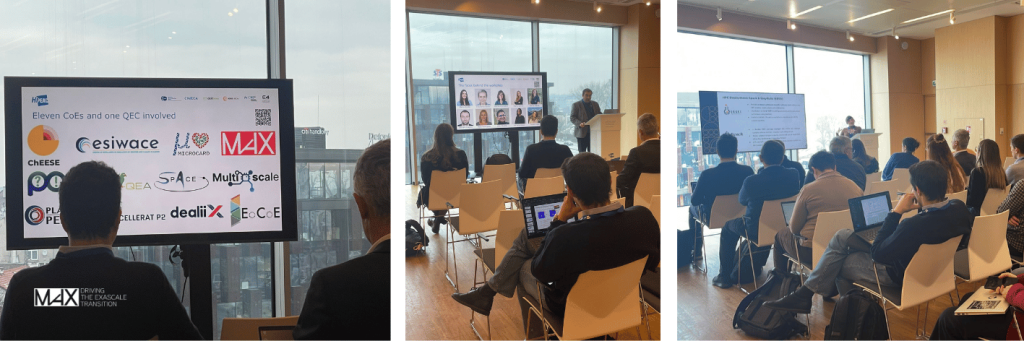
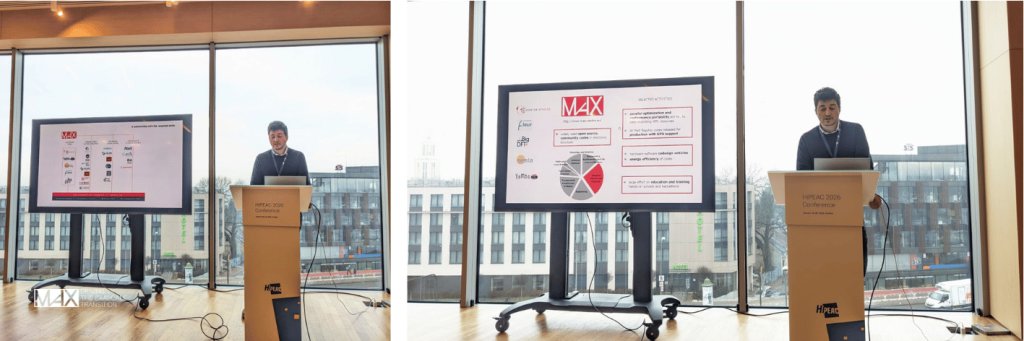
Andrea Ferretti (CNR-Nano), partner in the MaX Centre of Excellence, presented the talk “Materials design towards the exascale: codes, workflows and data”. His presentation described how MaX is preparing electronic structure simulations for next-generation supercomputers (download the slides).
Andrea started from the role of materials science in addressing societal challenges, including energy, environment, information technologies, and manufacturing. Electronic structure methods are now essential tools to predict materials properties before experimental validation. However, these methods are computationally demanding and must scale efficiently on modern architectures.
He described the MaX strategy to enable materials modelling on exascale-class machines. MaX focuses on widely used open-source electronic structure codes such as Quantum ESPRESSO, YAMBO, SIESTA, FLEUR, and BigDFT. These codes serve large international communities, and their modernization has a direct impact on many users.
A key part of the presentation was the optimization and porting of these codes to GPU-accelerated systems. Andrea explained how MaX teams analyze performance bottlenecks, redesign kernels, and introduce accelerator-aware algorithms to improve scalability and performance portability. He also highlighted the importance of exascale workflows, where simulation, data analysis, and data curation are integrated into reproducible pipelines. Such workflows support the production of curated datasets for materials properties, which are essential for data-driven materials discovery.
Collaboration among the European Centres of Excellence
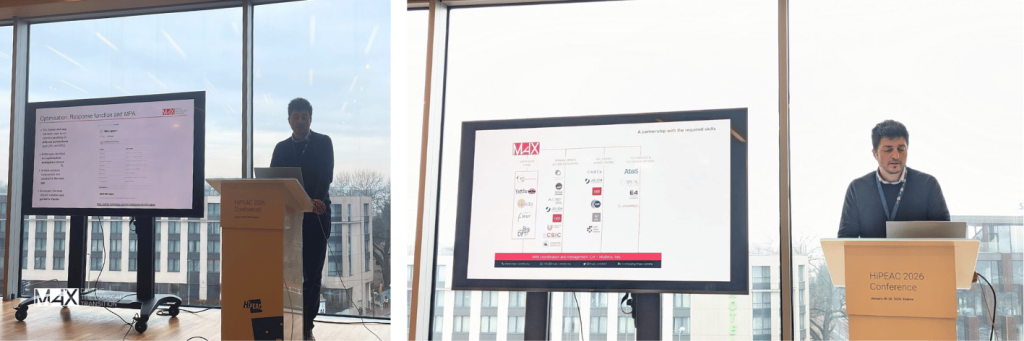
The workshop emphasized collaboration among CoEs working in different scientific domains, including climate science, bioinformatics, engineering, and performance analysis. Representatives from several CoEs, such as ESiWACE, BioExcel, ChEESE, ExCELLERAT, and others, shared their experiences in adapting applications to emerging architectures.
Common challenges were discussed, including performance portability, software sustainability, workflow automation, and integration of data and AI methods. For MaX, these discussions are valuable to align strategies and to share solutions with other communities. The meeting also encouraged contributions from early-career researchers and scientists from underrepresented groups, reinforcing the inclusive approach of the CoE ecosystem.
The workshop confirmed that the move to exascale is a broad transformation of scientific software, workflows, and collaboration models. By working together with other Centres of Excellence, MaX contributes to a coordinated European effort to modernize scientific applications for exascale computing. These collaborations strengthen the EuroHPC ecosystem and support the development of reliable, scalable, and sustainable tools for materials research.
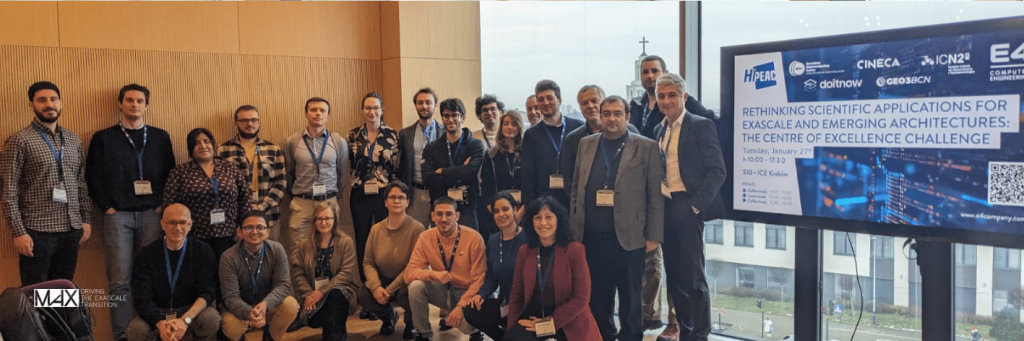
Photo credit: Nitin Shukla, Gabriella Bettonte, and Tiziana Liberati.
Conference material
Download the full agenda: HiPEAC26 AGENDA.
Download the Speaker Booklet: HiPEAC 2026 Speaker Booklet.
Download Andrea Ferretti’s PPT presentation: Ferretti_MaX_PPT_compressed.
For more information and the full programme, visit HiPEAC 2026 Event Page.
European Centres of Excellence Organizing Team
ESiWACE, EoCoE-III, MaX, ChEESE, ExCELLERAT, SPACE, MultiXscale, dealii-X, MICROCARD, POP, CEEC, HiDALGO2, BioExcel, Plasma-PEPSC.