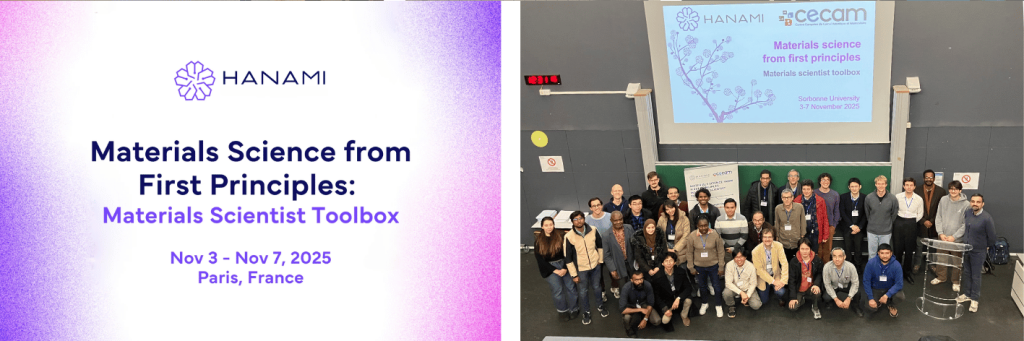

At the Materials Science from First Principles: Materials Scientist Toolbox workshop (3–7 November 2025, Sorbonne University, Paris), MaX partners Prof. Pablo Ordejón and Dr. Anthoni Alcaraz delivered a full day of lectures and hands-on training dedicated to SIESTA, one of the flagship codes supported by the MaX Centre of Excellence.
Their sessions introduced participants to modern, efficient electronic-structure simulations using density functional theory (DFT), a core technology for digital materials innovation. For industry professionals looking to accelerate R&D cycles and adopt simulation-driven materials screening, the SIESTA workflow offers a powerful entry point.
Driving Efficiency in Digital Materials R&D
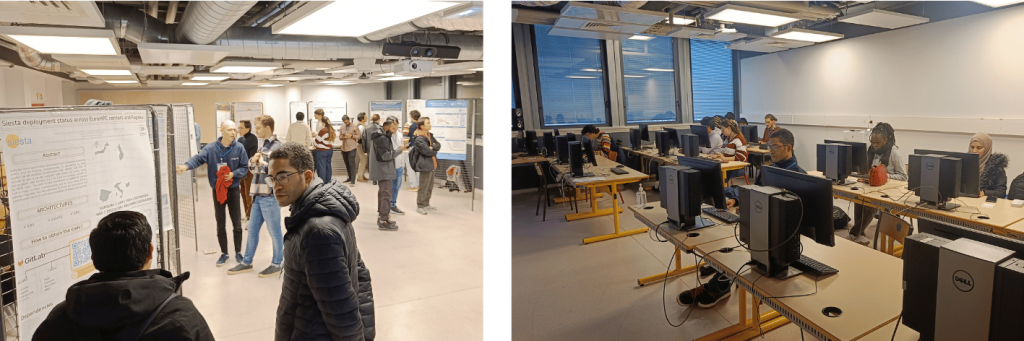
Prof. Ordejón opened the day with an accessible introduction to DFT and to the fundamental principles behind SIESTA’s design. His lectures highlighted how linear-scaling capabilities, optimized numerical algorithms, and high-performance data structures make SIESTA a strategic solution for industry sectors that require:
- fast turnaround times for electronic-structure calculations
- reliable predictions for materials performance
- scalable simulations on modern HPC architectures.
Industries such as energy, electronics, catalysis, manufacturing, and advanced materials increasingly rely on predictive modelling. SIESTA’s ability to handle large atomistic models while keeping costs under control is a competitive advantage for companies aiming to shorten development timelines.
Hands-On Sessions: From Basics to Practical Skills
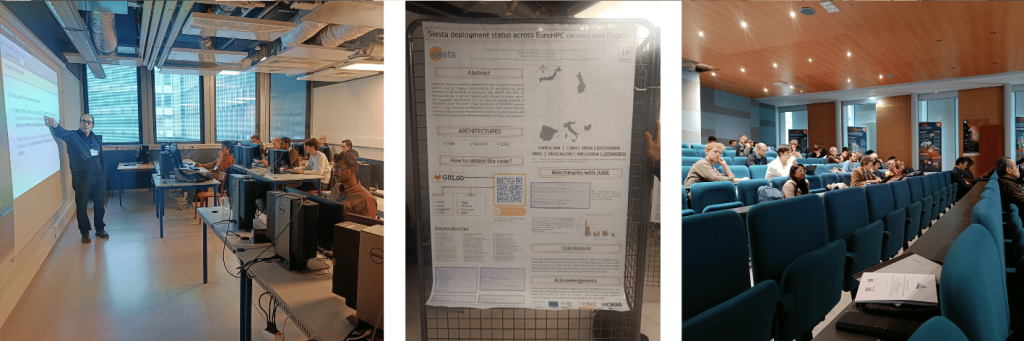
The afternoon practical sessions, co-led by Prof. Ordejón and Dr. Alcaraz, guided participants through key SIESTA workflows. These exercises were designed to translate scientific concepts into actionable skills relevant for industrial R&D teams.
Participants worked through:
- setting up and running their first SIESTA calculation
- understanding and optimizing the real-space grid
- efficient k-point sampling for reliable results
- managing the self-consistent-field (SCF) cycle for stable, converged simulations.
These tutorials showcased how engineers and applied researchers can integrate SIESTA into everyday modelling tasks—whether for screening new materials, analysing interfaces, or exploring structure-property relationships.
MaX CoE: Supporting the Adoption of HPC Materials Simulations
The MaX Centre of Excellence plays a central role in enabling European industry to benefit from HPC-powered materials modelling. Through continuous development of SIESTA and other leading codes, MaX ensures:
- performance portability on CPUs, GPUs and emerging accelerators
- seamless integration into modern HPC ecosystems
- improved reliability and reproducibility of simulations
- user-focused training and documentation.
The sessions at Sorbonne University reflect MaX commitment to helping the transition from traditional trial-and-error processes to data- and simulation-driven innovation pipelines.
Looking Ahead
As digital transformation accelerates in materials-intensive value chains, tools like SIESTA, as well as the expertise provided by MaX partners, allow companies to explore more design options, validate concepts earlier, and bring advanced materials to market faster. MaX will continue to collaborate with academic and industrial partners to deliver high-performance, scalable software environments tailored to real-world innovation challenges. If you are interested in adopting HPC-enabled materials modelling or collaborating with MaX, we welcome your engagement.
Lectures material available at:
Materials Science from First Principles: Materials Scientist Toolbox