
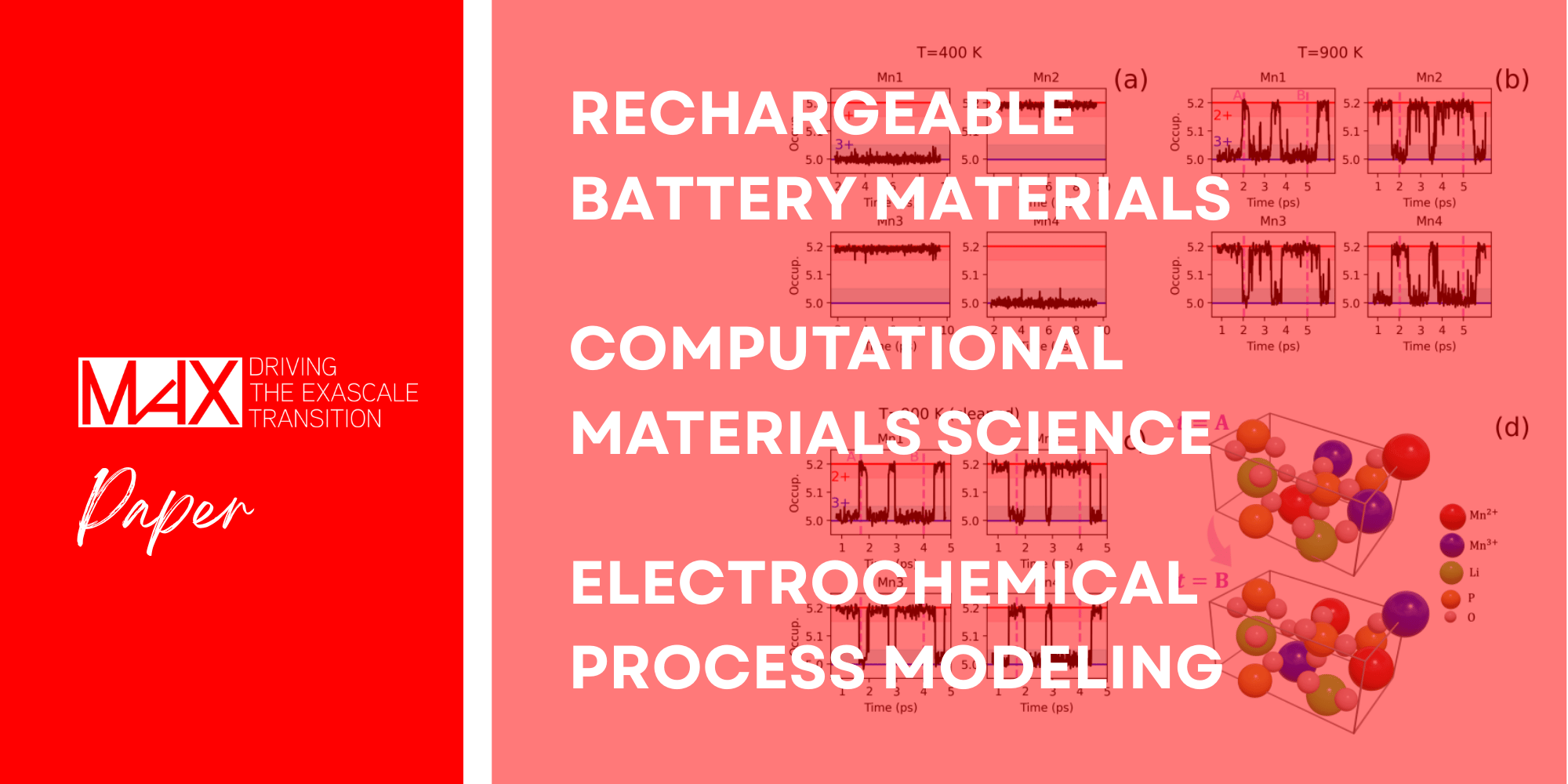
MaX researchers developed machine-learned potentials capable of tracking oxidation states in materials, enabling accurate modelling of redox processes in Li-ion cathodes and other technologically relevant systems.
Application sectors: Rechargeable battery materials, Computational materials science, Electrochemical process modelling.
Keywords: Oxidation states, DFT+U+V, Machine learning, Redox reactions, Li-ion cathodes.
Redox reactions, which involve changes in oxidation states of atoms, are central to the operation of technologies such as rechargeable batteries. Accurately modelling the evolution of these states is challenging with conventional first-principles methods due to self-interaction errors and the computational cost of simulating dynamic redox processes.
In this work, MaX researchers demonstrated that extended Hubbard functionals (DFT+U+V) molecular dynamics can reliably follow the adiabatic evolution of oxidation states in Li-ion cathode materials. Building on this, the team developed redox-aware machine-learned interatomic potentials that treat atoms of the same element in different oxidation states as distinct species. These potentials reproduce the correct ground-state configuration and oxidation-state patterns observed in first-principles simulations. The approach bridges the gap between the accuracy of quantum calculations and the efficiency of classical simulations, representing a notable advance in modeling redox-active materials.
Method
The research combined first-principles calculations with machine-learning techniques to create interatomic potentials capable of tracking oxidation states over time. DFT+U+V calculations, performed with Quantum ESPRESSO, provided accurate training data by mitigating self-interaction errors in systems with localized d or f electrons.
High-performance computing was essential to run molecular dynamics simulations on battery cathode materials and to generate sufficient training data for the machine-learning potentials. NequIP was employed to construct equivariant neural network potentials, which distinguish atoms with different oxidation states as separate species. This approach allowed a combinatorial search to identify the lowest-energy oxidation-state configuration, reproducing the adiabatic evolution observed in full first-principles molecular dynamics.
Conclusions
This method paves the way for systematic studies of complex redox processes in technologically relevant materials.
Talk to us about applying redox-aware machine-learned potentials in your materials research, or explore the open-source code repositories for Quantum ESPRESSO and NequIP to start experimenting with these methods.
Code availability
DFT+U+V calculations were performed using Quantum ESPRESSO v7.2 which is open source and can be freely downloaded from https://www.quantum-espresso.org. The machine learning machinery used is NequIP, which is open-source code and can be found https://github.com/mir-group/nequip.