
Researchers from MaX deliver a unified, high-accuracy method to compute transport coefficients from molecular dynamics, reducing simulation cost while improving statistical reliability across liquids and solid-state electrolytes.
Application sectors: Energy • Materials • Mobility
Keywords: Green–Kubo theory • Transport coefficients • Molecular dynamics • Spectral analysis • Solid-state electrolytes
Predicting how heat, mass, and charge move through materials is essential for energy conversion, thermal management, and electrochemical devices. Transport coefficients such as thermal conductivity, electrical conductivity, viscosity, and thermoelectric response are central to the design of batteries, solid-state electrolytes, and heat-management materials. These properties are routinely computed using Green–Kubo theory and equilibrium molecular dynamics, but the required simulations are long and the statistical uncertainty is hard to quantify.
Standard Green–Kubo approaches suffer from noisy time correlations and unreliable error estimates, especially for coupled transport effects like thermoelectricity. Existing spectral techniques help, but they treat diagonal and off-diagonal coefficients separately and may introduce bias in complex systems. This limits predictive simulations for technologically relevant materials, including ionic conductors.
The team of researchers including MaX members introduced a single, statistically rigorous method that estimates the entire Onsager matrix of transport coefficients at once. The approach improves accuracy, provides robust error bars, and works for liquids, molten salts, and solid-state electrolytes such as Li₃PS₄. The results are validated against benchmark systems and advanced Bayesian methods.
Unified spectral estimation at scale
The work reformulates transport analysis in the frequency domain. Instead of integrating noisy time correlations, the method fits the zero-frequency limit of current power spectra using a statistically exact model based on Wishart distributions. This requires large-scale equilibrium molecular dynamics trajectories and fast Fourier transforms, making high-performance computing essential.
Simulations and data analysis were carried out on leadership-class HPC systems supported by the MaX Centre of Excellence, enabling long trajectories and extensive validation.
The analysis builds on SPORTRAN, a software for transport properties from molecular dynamics, extended here with a new Wishart-based likelihood estimator. Large-scale simulations employed GPUMD together with machine-learning interatomic potentials trained on first-principles data generated with MaX lighthouse code QUANTUM ESPRESSO.
The team including MaX researchers combined deep expertise in statistical mechanics, spectral analysis, and scalable software. By modeling the full spectral matrix with a positive-definite representation and optimizing it via likelihood minimization, the method avoids ad-hoc assumptions and unifies diagonal and off-diagonal transport coefficients in one framework. Model selection is automated using information criteria, ensuring robustness without manual tuning.
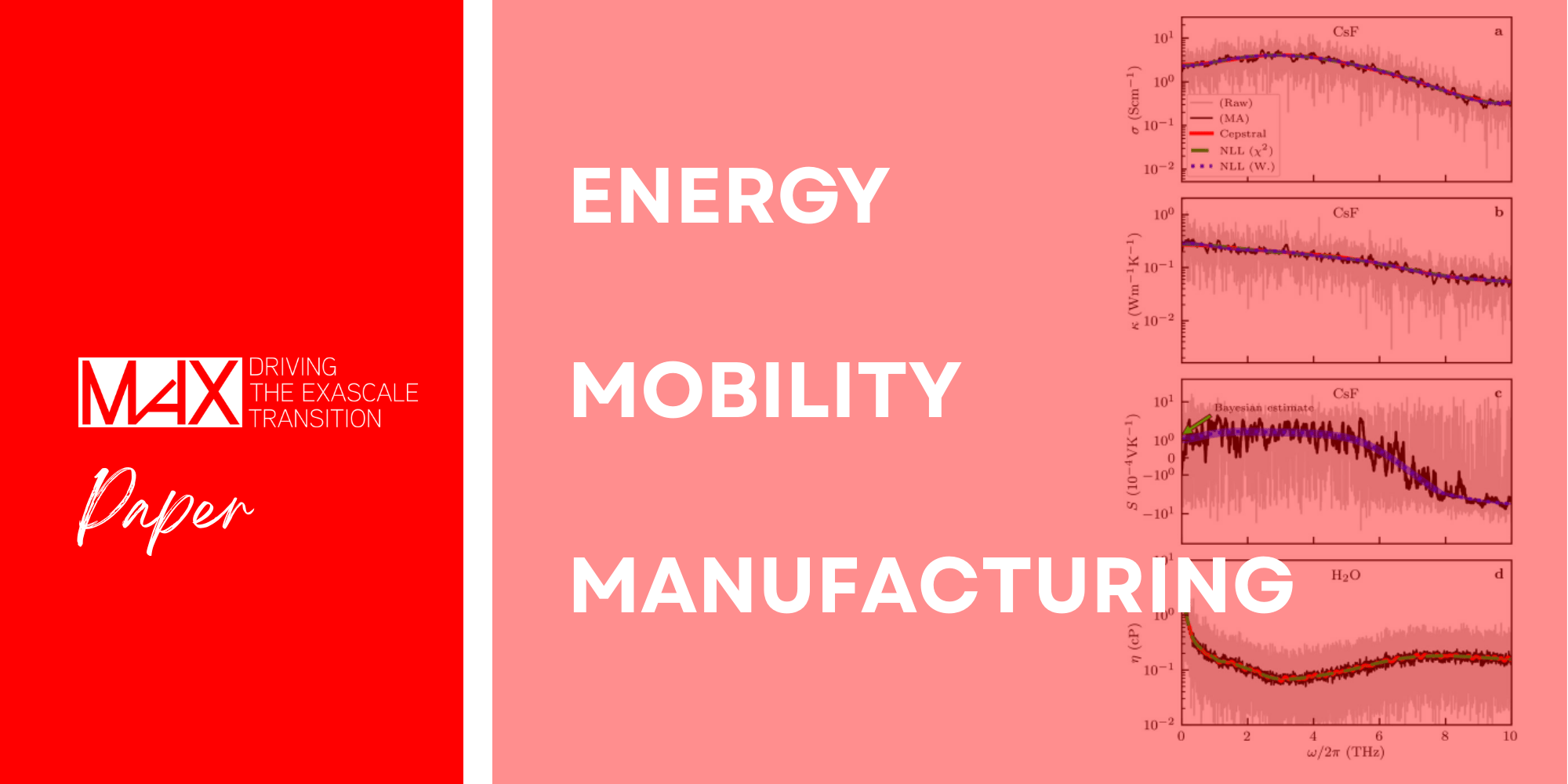
The new estimator reproduces electrical and thermal conductivities, viscosities, and Seebeck coefficients with accuracy comparable to advanced Bayesian Monte Carlo methods but at a fraction of the computational cost. Benchmarks on molten CsF and liquid water confirm reliability. The method was then applied to the solid-state electrolyte Li₃PS₄, delivering consistent transport coefficients across phases and temperatures—critical data for battery research.
From theory to materials design
This research delivers a practical and rigorous solution to a long-standing problem in molecular simulations. By solving the issue of statistical noise and uncertainty estimation, it makes equilibrium molecular dynamics a more reliable predictive tool for transport properties.
The method directly benefits energy materials research, especially solid-state batteries and ionic thermoelectrics. It also opens the door to routine, high-throughput screening of transport properties using HPC and machine-learning potentials. More broadly, it strengthens Europe’s capability in materials modelling by combining theory, algorithms, and scalable software.
The software used in this study is openly available. Talk to the MaX team to apply this approach to your materials challenges.