
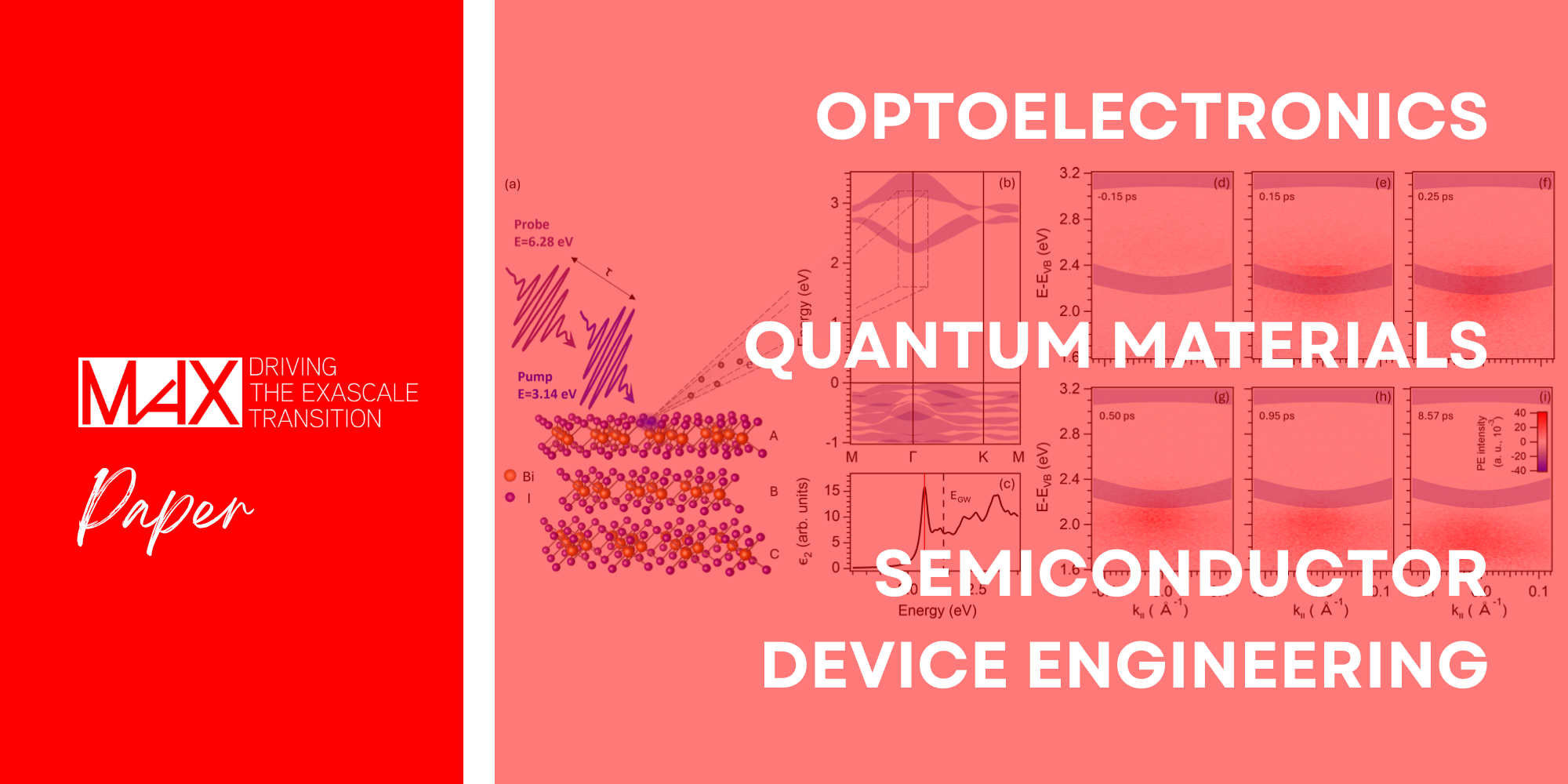
Application sectors: Optoelectronics, Quantum materials, Semiconductor device engineering.
Keywords: excitons, tr-ARPES, ultrafast dynamics, ab initio, layered semiconductors.
Excitons govern the optical and electronic response of semiconductors, yet their earliest formation stages have remained largely hidden. Traditional optical techniques can only probe “bright” excitons, leaving dark states, momentum distributions, and the full relaxation cascade unresolved.
This work tackles a central challenge: how excitons emerge from photoexcited carriers and evolve across time, energy, and momentum. Using time- and angle-resolved photoemission spectroscopy (tr-ARPES), the study captures the full nonequilibrium pathway in the layered semiconductor BiI₃.
The novelty of this study lies in achieving a simultaneous, multidimensional view (time, energy, and momentum) of exciton formation, including both free carriers and bound states within a unified framework.
The key finding is the direct observation of exciton formation from quasi-free carriers within ~120 femtoseconds. Initially, photoexcitation generates free electrons in the conduction band. These rapidly evolve into bound excitons localized at zero momentum (k∥ = 0). The transition is marked by a change in dispersion from electron-like to hole-like, revealing the onset of exciton formation and subsequent trapping.
Additionally, the exciton wavefunction is reconstructed in real space, showing a spatial extension over roughly seven BiI₃ clusters. This provides a rare link between momentum-space measurements and real-space excitonic structure.
Implications
This work presents early-stage exciton dynamics, revealing how free carriers transition into bound excitons and eventually localize into trapped states on ultrafast timescales.
Understanding and controlling exciton formation is foundational for next-generation technologies:
- In optoelectronics, it enables faster and more efficient light–matter interactions
- In valleytronics and spintronics, it opens pathways to manipulate quantum degrees of freedom
- In semiconductor engineering, it supports ultrafast switching and information processing
The study demonstrates that combining advanced spectroscopy with HPC-driven many-body simulations is the key to unlocking these phenomena. Looking ahead, extending this framework to other low-dimensional and strongly correlated materials could accelerate the design of devices operating at femtosecond timescales.
Interested in simulating excitonic effects or leveraging MaX tools for your research? Explore the Quantum ESPRESSO code and connect with the MaX Centre of Excellence to bring HPC-powered materials discovery into your workflow.
Reference paper
Unveiling the exciton formation in time, energy and momentum domain in layered van der Waals semiconductors. V. Gosetti, J. Cervantes-Villanueva, S. Mor, D. Sangalli, A. García-Cristóbal, A. Molina-Sánchez, V. F. Agekyan, M. Tuniz, D. Puntel, W. Bronsch, F. Cilento, and S. Pagliara Progress in Surface Science 100, 2, 100777 (2025). https://doi.org/10.1016/j.progsurf.2025.100777