Energy efficiency
MaX is devoting significant effort in studying the impact of runtime execution parameters on energy efficiency. Our work presents findings that offer HPC system administrators and code users some strategies to reduce energy consumption with minimal effort.
Alongside the deployment of MaX codes on EuroHPC systems, significant work has focused on studying how runtime execution parameters affect energy efficiency. The findings, presented in Deliverable D4.2, offer guidance to HPC system administrators and code users on reducing energy consumption with minimal effort.
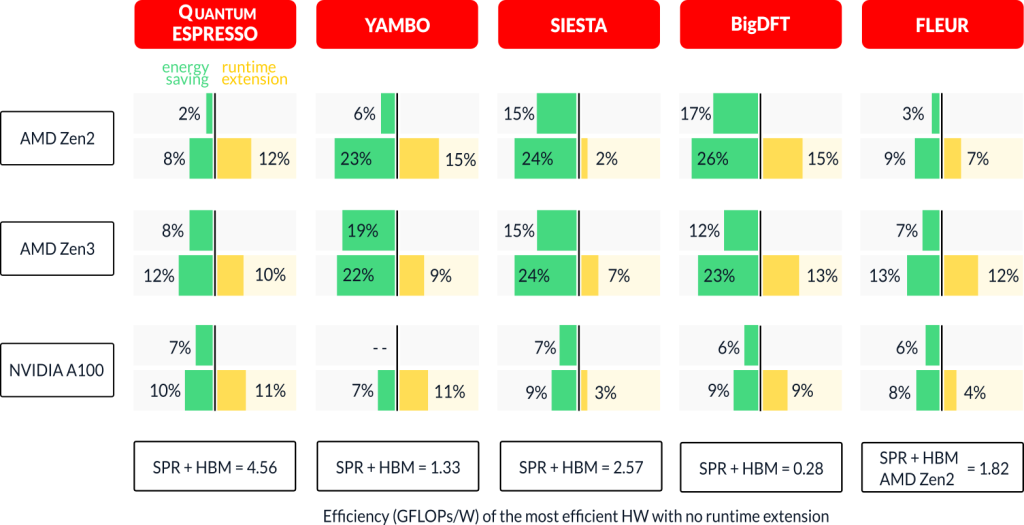
These studies examined energy use on major EuroHPC hardware platforms, including AMD Zen2 and Zen3 CPUs and Nvidia A100 GPUs. Results show that static tuning (that is, setting CPU frequencies before running simulations) can lead to meaningful energy savings. For example, moderate tuning can reduce energy usage without affecting execution time, while more aggressive tuning can achieve up to 26% savings with only a slight increase in runtime. Further savings may be possible through dynamic tuning, which adjusts hardware settings during execution. These techniques could help cut energy use significantly without impacting performance.
This work supports the EuroHPC goal of more sustainable supercomputing. The results will continue to guide HPC centres and users in optimising energy usage while maintaining performance, reducing the environmental footprint of scientific computing with MaX codes.
Energy consumption reduction
In the table below, we highlight the studies conducted on AMD Zen2 and Zen3 CPU architectures and Nvidia A100 GPUs, which form a substantial part of EuroHPC systems. The results demonstrate that static tuning can achieve notable energy savings without significantly affecting runtime. In some cases, energy consumption can be reduced with no noticeable impact on execution time, while more aggressive tuning can yield up to 26% energy savings with an acceptable increase in runtime.